Window mode follows your eyes with your camera, in this browser only: no picture or position leaves your device.
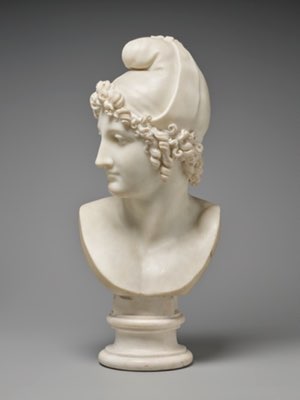
Proserpine
Hiram Powers (born Woodstock, VT 1805-died Florence, Italy 1873)
1839-1873
- Medium
- marble
- Classification
- Sculpture
- Dimensions
- 25 x 20 x 11 in. (63.5 x 50.8 x 27.9 cm)
- Museum
- Smithsonian Institution, Smithsonian American Art Museum, Painting and Sculpture
- Credit line
- Smithsonian American Art Museum, Gift of Mrs. George Cabot Lodge
- Rights
- CC0 (Smithsonian Open Access), as the museum states it.
- Who can see it
- Teens profiles and older: its subject is for older viewers (war, death, the Passion, drink or the like). How works are placed
View at the Smithsonian Institution
About this work
Proserpine (or Persephone) is a character from Greek mythology who was forced to spend part of every year in the underworld. Her absence from the earth was believed to cause winter, while her return brought spring. Hiram Powers modeled the original bust of Proserpine to include an elaborate woven basket filled with flowers. This proved too time-consuming and expensive to carve, however, and it was changed to a simple arrangement of acanthus leaves. Proserpine was replicated more than any other work produced by an American sculptor during the nineteenth century, and Powers’s studio carved more than three hundred copies.