Window mode follows your eyes with your camera, in this browser only: no picture or position leaves your device.
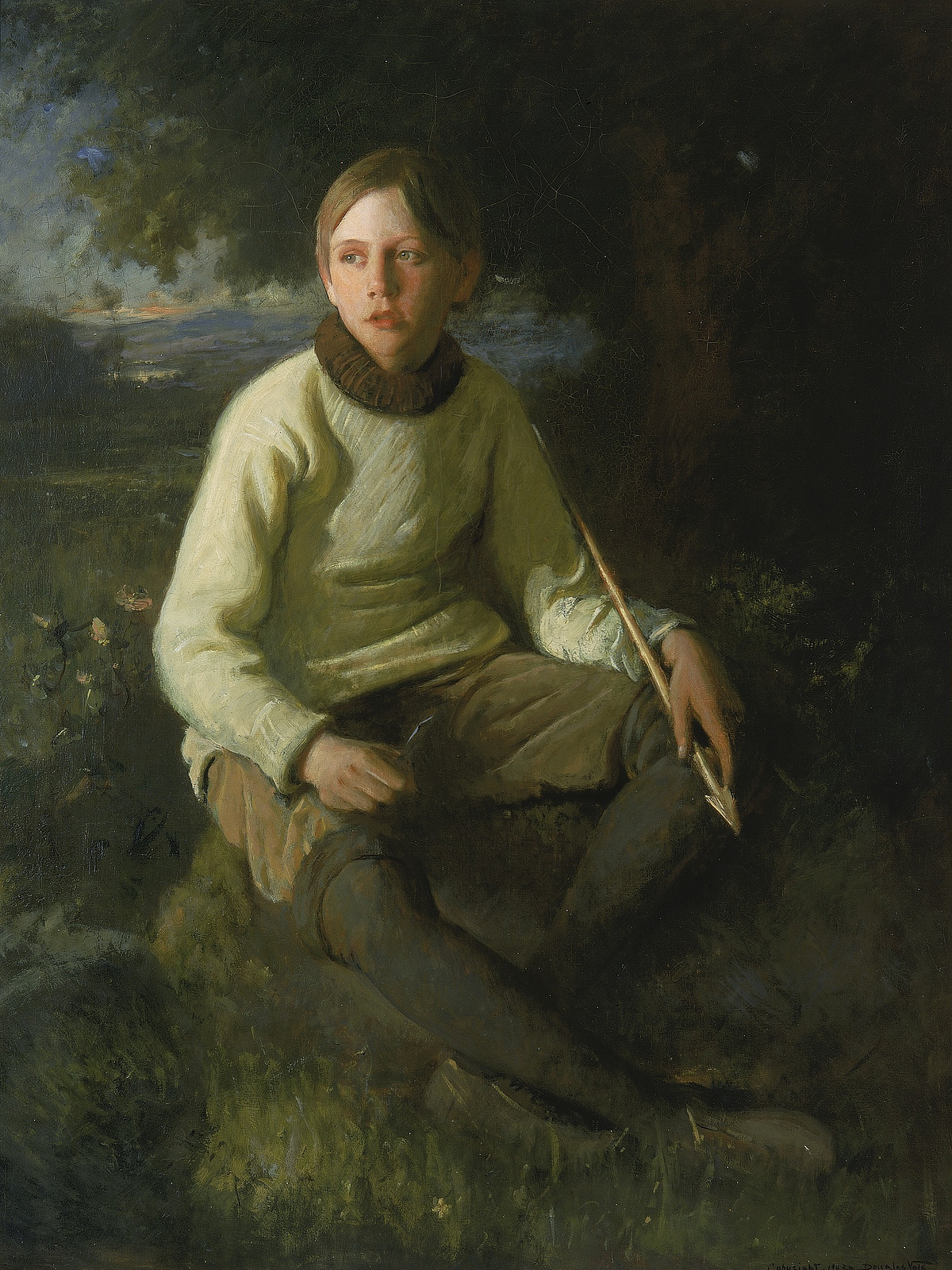
The Boy with the Arrow
Douglas Volk (born Pittsfield, MA 1856-died Fryeburg, ME 1935)
1903
- Medium
- oil on canvas
- Classification
- Paintings
- Dimensions
- 46 1/8 x 36 1/8 in. (117.1 x 91.6 cm.)
- Museum
- Smithsonian Institution, Smithsonian American Art Museum, Painting and Sculpture
- Credit line
- Smithsonian American Art Museum, Gift of William T. Evans
- Rights
- CC0 (Smithsonian Open Access), as the museum states it.
- Who can see it
- Tweens profiles and older: its subjects are known and suit older children. How works are placed
View at the Smithsonian Institution
About this work
Douglas Volk’s son, Leo, sits in a lush field at twilight, catching his breath from a day's excitement outdoors. He holds the arrow in a relaxed grip, as a confident young hunter would carry his spear. Leo occupies a transitional time in life, no longer a boy and not yet a man. In the early twentieth century the term "adolescence" came into popular use, and psychologists encouraged parents to guide their children through these turbulent years (Mintz, Huck's Raft: A History of American Childhood, 2004). The character of Peter Pan, a boy who did not want to grow up, first appeared in the pages of Scribner’s Magazine the year before this painting was made. In this climate, Volk exhibited the painting at the 1904 St. Louis World’s Fair to great acclaim. He pictured his son as an energetic American boy, but the classical, pastoral setting also conveyed a timeless ideal of youth on the verge of adulthood.