Window mode follows your eyes with your camera, in this browser only: no picture or position leaves your device.
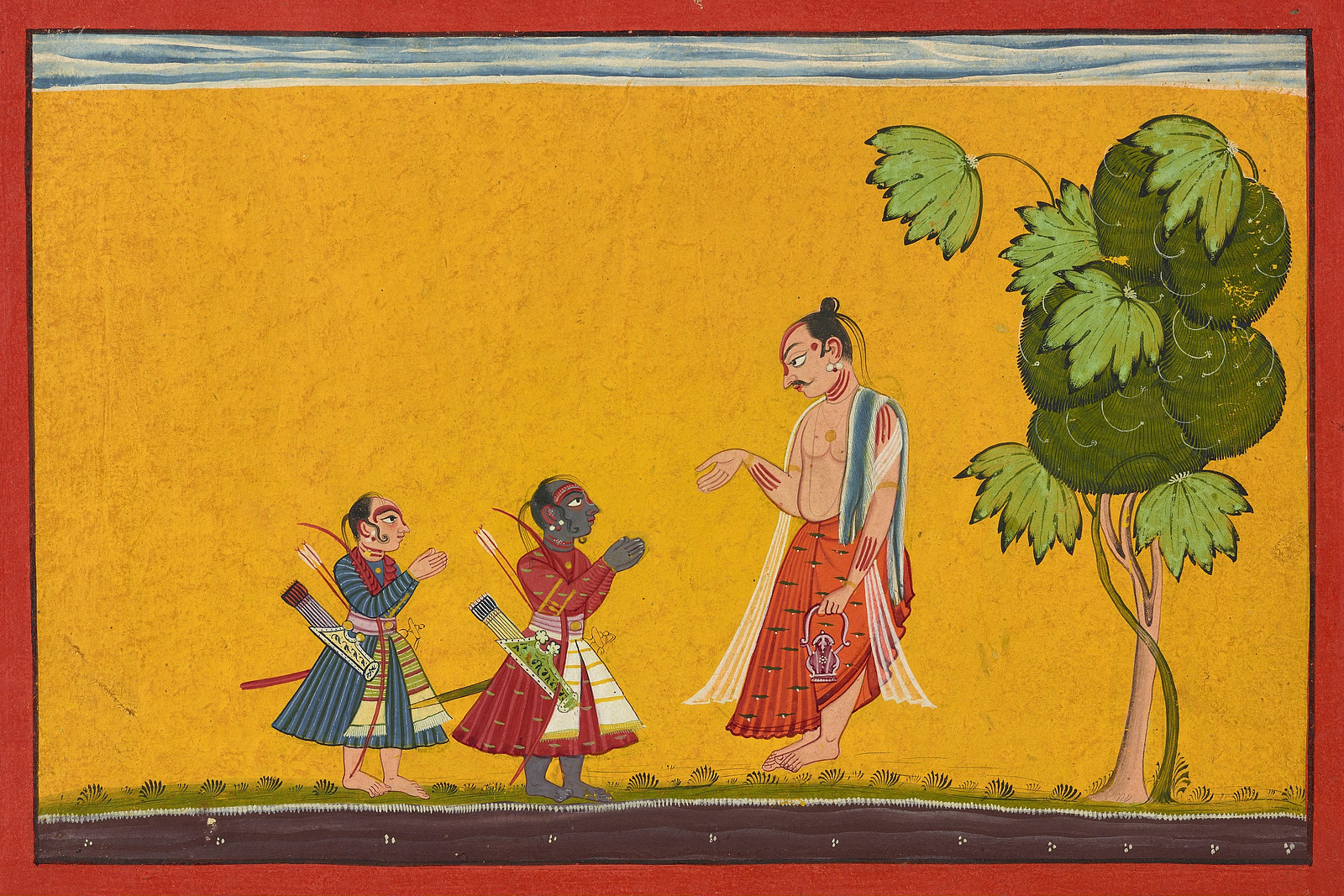
Rama and Lakshman with the sage Vishvamitra, from a <em>Ramayana</em>
Attributed to the Master of Style II of the ‘Shangri’ Ramayana
ca. 1680-1690
- Medium
- Opaque watercolor on paper
- Classification
- Paintings
- Dimensions
- H x W (painting): 19 × 29.2 cm (7 1/2 × 11 1/2 in)
- Culture
- Himalayan peoples
- Museum
- Smithsonian Institution, National Museum of Asian Art
- Credit line
- Purchase and partial gift from the Catherine and Ralph Benkaim Collection — funds provided by the Friends of the National Museum of Asian Art
- Rights
- CC0 (Smithsonian Open Access), as the museum states it.
- Who can see it
- Teens profiles and older: its museum says too little about what it shows to place it for younger viewers. How works are placed
View at the Smithsonian Institution
About this work
The scene takes place outside Ayodhya, in the uncultivated forest zone where ascetics dwell. The boys raise their hands respectfully as they listen to the divine sage Vishvamitra, who has brought them to the forest zone in order to kill the demons who disturb holy men. Vishvamitra wears an animal skin over one shoulder and carries a water pot (kundika). With their bows and arrows slung across their bodies, the brothers have long wavy sideburns, large lotus-shaped eyes, and richly colored jamas. All three figures bear red Vaishnava tilaks (forehead marks). The landscape is a glowing field of golden yellow, sandwiched between a thin strip of cloudy sky and a narrow band of tufted grass. A deep maroon river borders the foreground. With its shaggy tufts of dark green, the tree is made marvelous by a vine of absolutely massive fig leaves.