Window mode follows your eyes with your camera, in this browser only: no picture or position leaves your device.
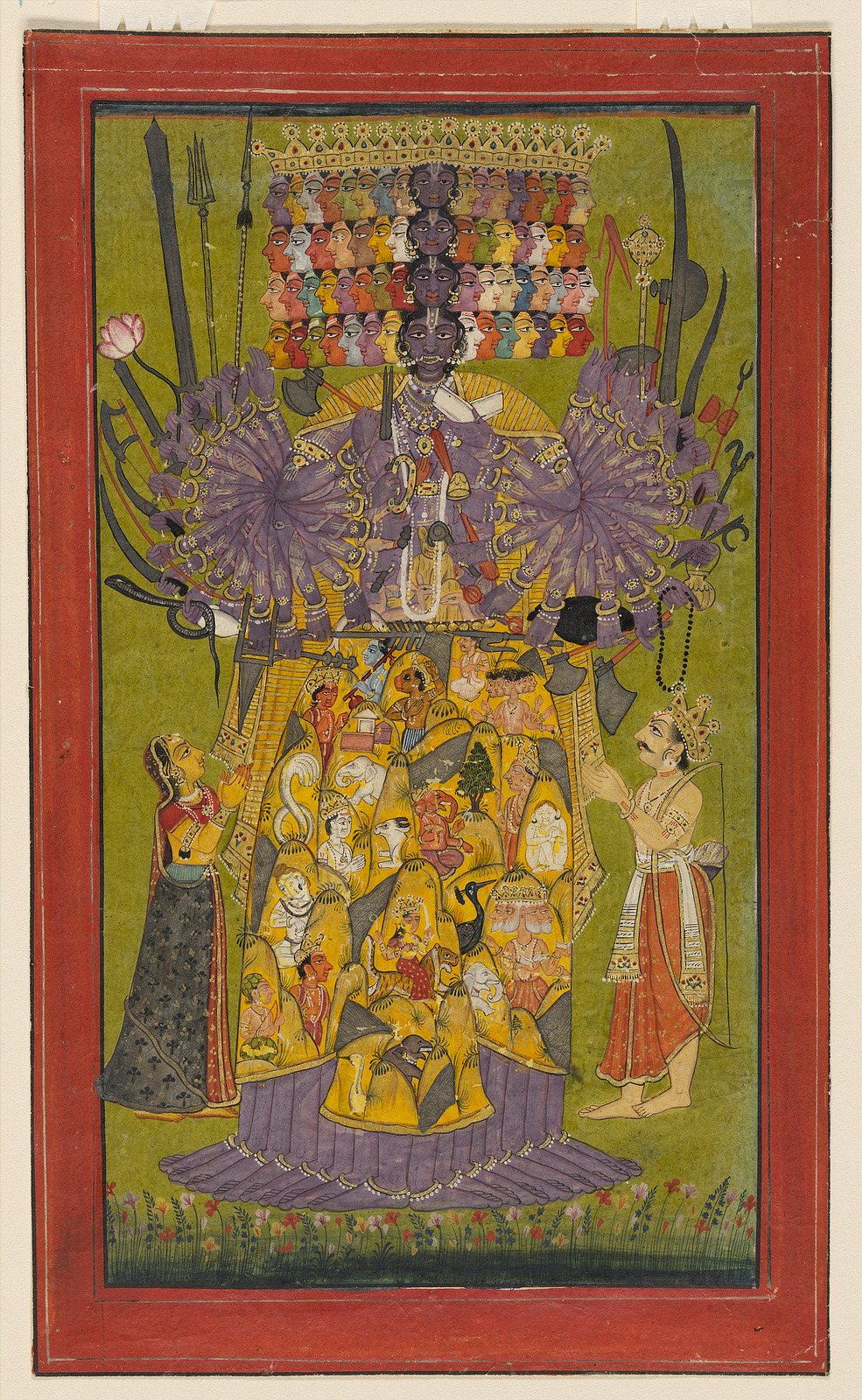
Krishna Vishvarupa
ca. 1740
- Medium
- Opaque watercolor and gold on paper
- Classification
- Paintings
- Dimensions
- H x W (overall): 19.8 × 11.7 cm (7 13/16 × 4 5/8 in)
- Culture
- Himalayan peoples
- Museum
- Smithsonian Institution, National Museum of Asian Art
- Credit line
- Purchase and partial gift from the Catherine and Ralph Benkaim Collection — funds provided by the Friends of the National Museum of Asian Art
- Rights
- CC0 (Smithsonian Open Access), as the museum states it.
- Who can see it
- Tweens profiles and older: its subjects are known and suit older children. How works are placed
View at the Smithsonian Institution
About this work
The Bhagavad Gita (200 BCE-300 CE) is one of Hinduism's most sacred texts, and Krishna's manifestation as the cosmos is its profound core. The text presents a spectrum of doctrines and practices within a framework of personal devotion (bhakti) to Krishna. The eleventh chapter describes Krishna in his infinite cosmic form, vishvarupa, which encompasses all of time and "the whole world, moving and unmoving," filling "all the horizons," and "brushing the sky."