Window mode follows your eyes with your camera, in this browser only: no picture or position leaves your device.
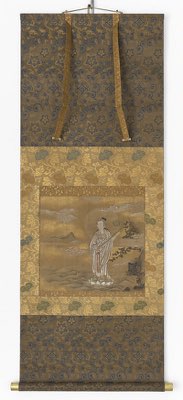
Miracles performed by the bodhisattva Jizo (copy of a section of a handscroll)
1627
- Medium
- Ink and color
- Classification
- Paintings
- Dimensions
- H x W: 125 x 13.3 cm (49 3/16 x 5 1/4 in)
- Culture
- Buddhists
- Museum
- Smithsonian Institution, National Museum of Asian Art
- Credit line
- Gift of Charles Lang Freer
- Rights
- CC0 (Smithsonian Open Access), as the museum states it.
- Who can see it
- Tweens profiles and older: its subjects are known and suit older children. How works are placed
View at the Smithsonian Institution
About this work
This early narrative handscroll (emakimono) depicts miraculous stories of the compassionate bodhisattva Jizo (Kshitigarbha), a Buddhist deity worshipped as a savior of those condemned to hell. With the scroll, Freer acquired a final copy of the section, done in 1627 by Kano Tan'yu. The copy shows text that was later lost from the original scroll. Freer’s acquisition of such copies and preliminary drawings, in addition to finished works of art, expressed his commitment to their research value, which was unusual among collectors at the time. Freer purchased this handscroll in 1907 from the art dealer Nomura Yozo (1870–1965), whose firm in Yokohama, Japan, was known as Samurai Shokai. Nomura commissioned decorative handcrafts designed for export, and he also sold Asian antiquities.