Window mode follows your eyes with your camera, in this browser only: no picture or position leaves your device.
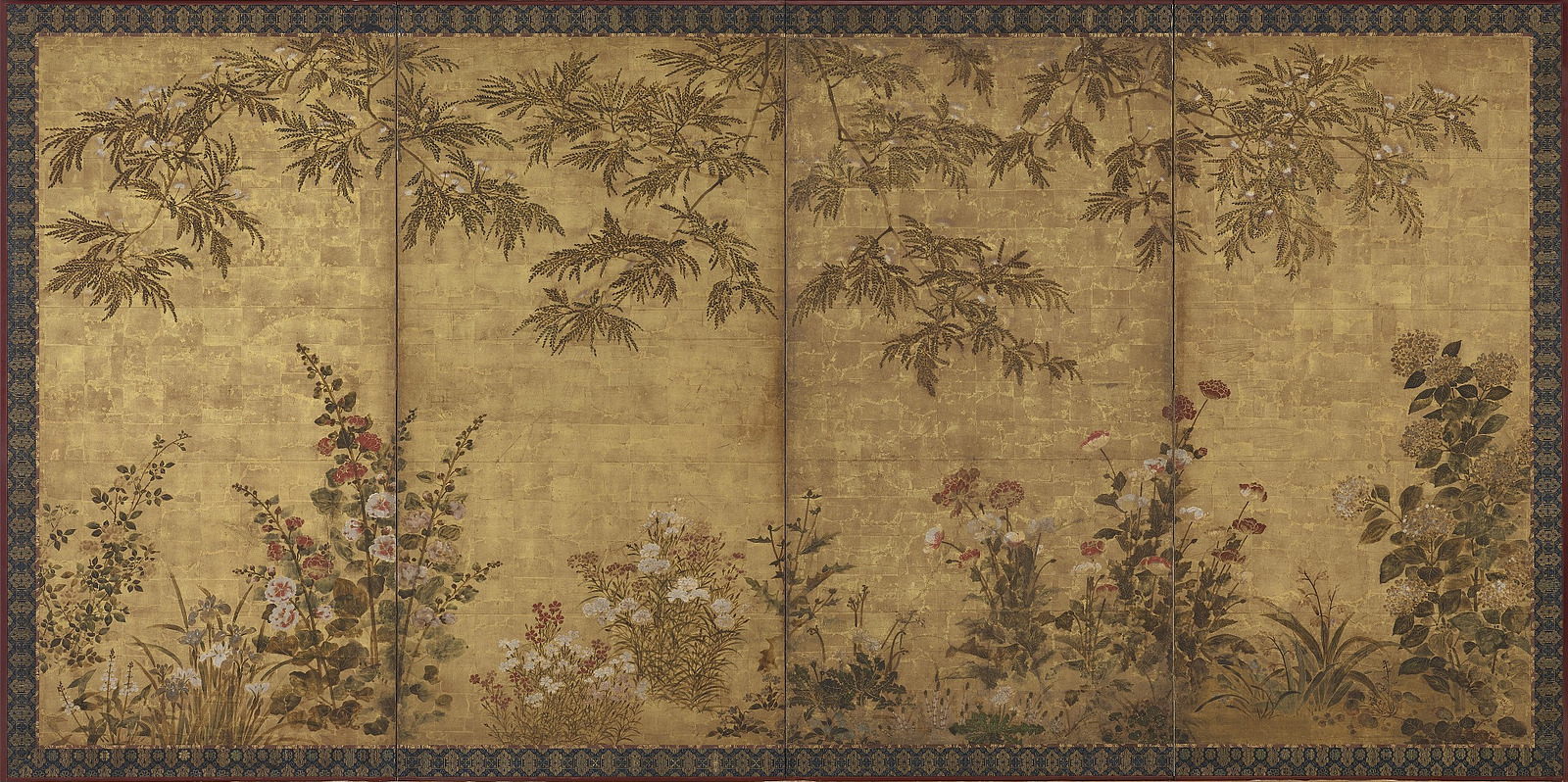
Mimosa tree, poppies and other summer flowers 合歓木芥子図屏風
Tawaraya Sosetsu 俵屋宗雪 (active mid-17th century)
1630-1670
- Medium
- Ink, color and gold on paper
- Classification
- Paintings
- Dimensions
- H x W: 167.4 x 353.4 cm (65 7/8 x 139 1/8 in)
- Culture
- Japanese
- Museum
- Smithsonian Institution, National Museum of Asian Art
- Credit line
- Gift of Charles Lang Freer
- Rights
- CC0 (Smithsonian Open Access), as the museum states it.
- Who can see it
- Little Ones profiles and older: it shows gentle subjects for the very young. How works are placed
View at the Smithsonian Institution
About this work
Against a gold-leafed background, a lush garden grows beneath the fronds of a mimosa tree. The artist has expertly applied thin washes of ink and pigment, allowing the color to pool, suggesting the variations in natural hues of foliage and flowers. This folding screen was constructed from four individual sliding panels that would have been set in rails between two rooms. The artist is identified only by a circular seal, I'nen, which identifies the painter as a member of the atelier of Sotatsu (active circa 1600-1640). Sotatsu was an innovative artist whose distinctive style of painting was carried on intermittently by artists of the Rimpa School, named after Ogata Korin (1658-1716) and characterized by innovative ideas about design and materials. More than one artist used the I'nen seal, but among Sotatsu's followers, Sosetsu's reputation was the most prominent. Because of its high artistic and technical quality, this screen has traditionally been associated with his name.