Window mode follows your eyes with your camera, in this browser only: no picture or position leaves your device.
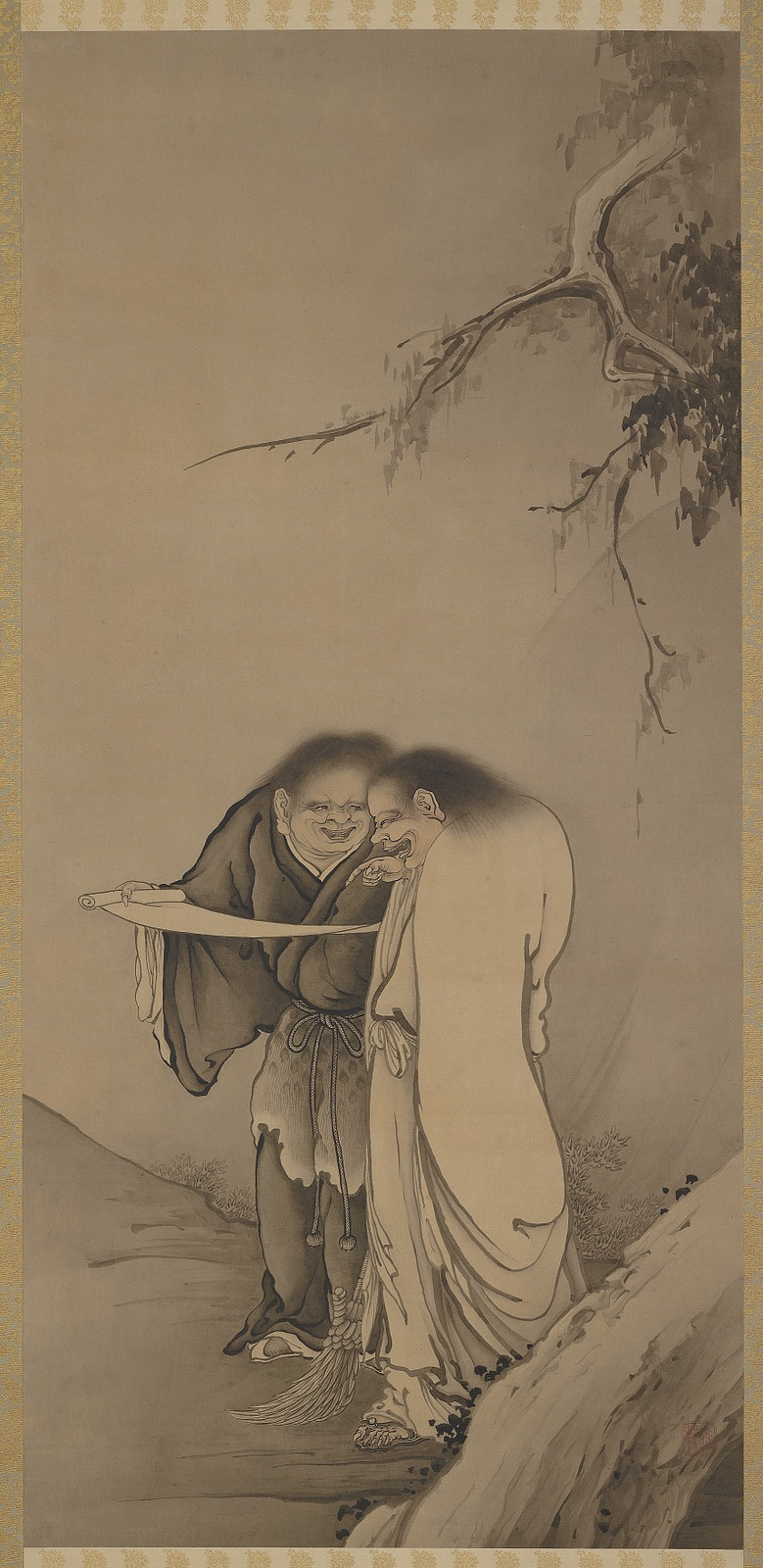
The Chinese Taoist Immortals, Han-shan and Shih-te (Kanzan and Jittoku)
Hashimoto Gaho 橋本雅邦 (1835-1908)
1886
- Medium
- Ink and slight tint on paper
- Classification
- Paintings
- Dimensions
- H x W (image): 122 × 58.1 cm (48 1/16 × 22 7/8 in)
- Culture
- Japanese
- Museum
- Smithsonian Institution, National Museum of Asian Art
- Credit line
- Gift of Charles Lang Freer
- Rights
- CC0 (Smithsonian Open Access), as the museum states it.
- Who can see it
- Teens profiles and older: its museum says too little about what it shows to place it for younger viewers. How works are placed
View at the Smithsonian Institution
About this work
The Chinese hermits known in Japanese as Kanzan (Hanshan in Chinese) and Jittoku (Shide in Chinese), lived near the sacred mountain Tiantaishan during the Tang dynasty (618-907). They appear frequently in Zen Buddhist paintings, in which they represent rejection of the secular world. Here Kanzan opens a scroll of his poetry, while Jittoku, a servant at a monastery, looks on.