Window mode follows your eyes with your camera, in this browser only: no picture or position leaves your device.
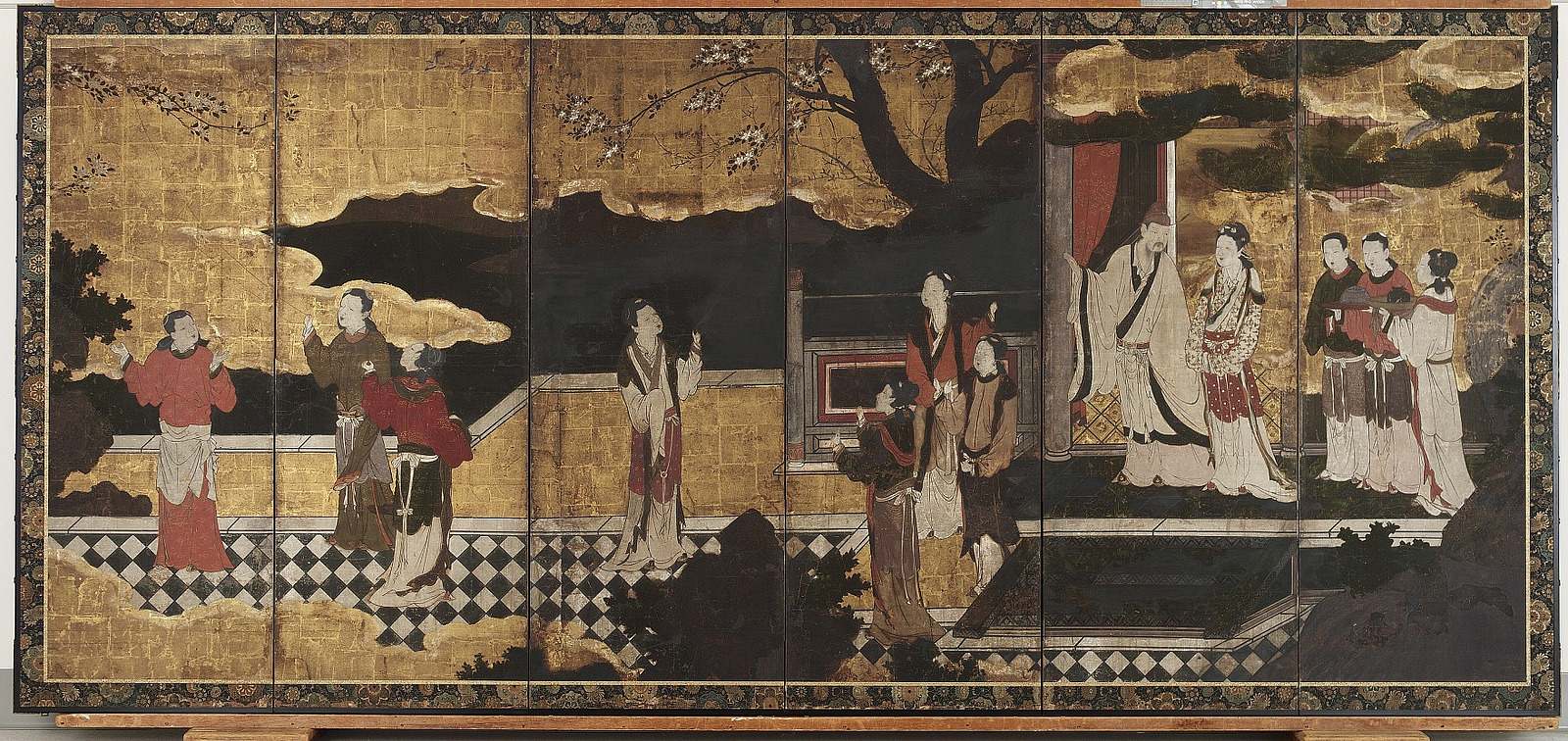
The Chinese Emperor Minghuang and his concubine Yang Guifei, with attendants on a terrace
16th century
- Medium
- Ink, color, and gold on paper
- Classification
- Paintings
- Dimensions
- H x W: 156.7 x 360.6 cm (61 11/16 x 141 15/16 in)
- Culture
- Japanese
- Museum
- Smithsonian Institution, National Museum of Asian Art
- Credit line
- Gift of Charles Lang Freer
- Rights
- CC0 (Smithsonian Open Access), as the museum states it.
- Who can see it
- Teens profiles and older: its subject is for older viewers (war, death, the Passion, drink or the like). How works are placed
View at the Smithsonian Institution
About this work
Few works of Chinese literature have so enthralled the Japanese people as The Song of Everlasting Sorrow, a narrative poem by the Chinese poet Bo Juyi (772-846) of the Tang dynasty (618-907). The poem recounts the tragic story of Emperor Xuanzong (reigned 712-756), commonly known as Minghuang, whose excessive love for his beautiful concubine, Yang Guifei (circa 720-756), led to intrigue at court and disorder in the empire. Yang Guifei was put to death in 756 during the An Lushan uprising. The passionate love and inconsolable grief portrayed in the Chinese poem found a sympathetic reception in the Japanese imperial court of the Heian period (794-1185), where the emotional entanglements of Japanese aristocrats became the theme of The Tale of Genji, an important work of narrative fiction written by a noblewoman, Murasaki Shikibu.