Window mode follows your eyes with your camera, in this browser only: no picture or position leaves your device.
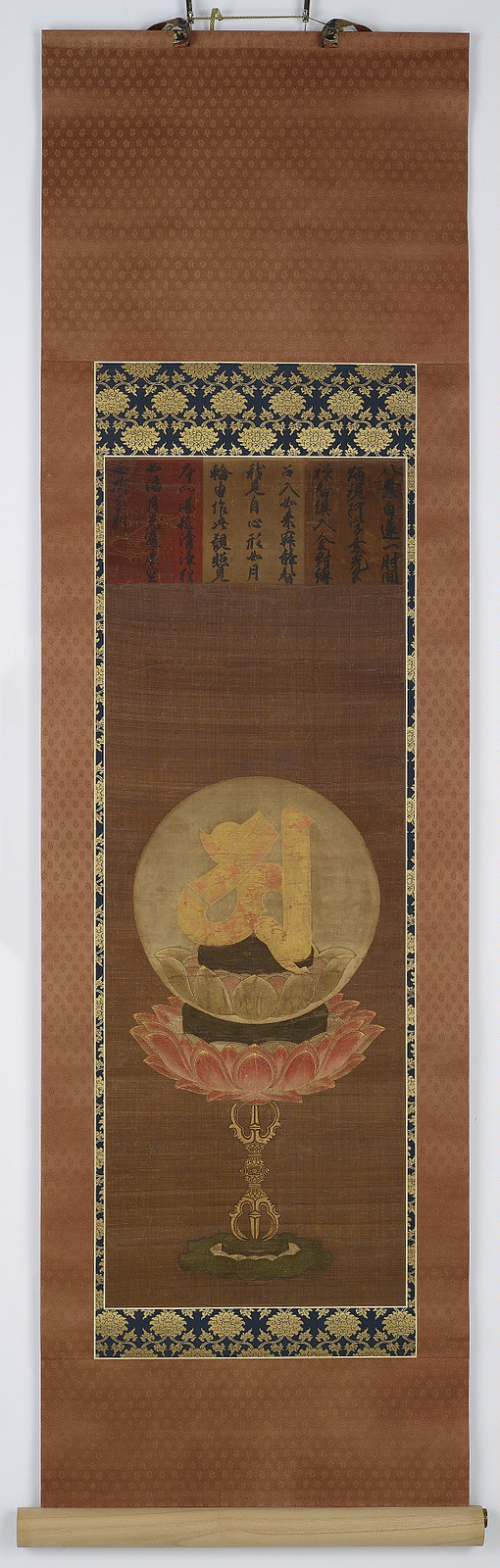
The Bija A, representing Vairocana (Dainichi)
late 14th-early 15th century
- Medium
- Color and gold on silk
- Classification
- Paintings
- Dimensions
- H x W (image): 120.7 x 42.4 cm (47 1/2 x 16 11/16 in)
- Culture
- Buddhists
- Museum
- Smithsonian Institution, National Museum of Asian Art
- Credit line
- Gift of Charles Lang Freer
- Rights
- CC0 (Smithsonian Open Access), as the museum states it.
- Who can see it
- Tweens profiles and older: its subjects are known and suit older children. How works are placed
View at the Smithsonian Institution
About this work
In Japanese Buddhist art, characters representing syllables of the Indian Sanskrit language occasionally symbolized Buddhist deities. Sanskrit syllables, whether written, painted, or spoken, derived their power from their historical association with India, the homeland of the Historical Buddha and the site of his original teachings. In this image, the syllable "a" is enthroned on a lotus, a Buddhist symbol of purity, and surrounded by a circle representing light. This syllable was the symbol for the Cosmic Buddha (Japanese, Dainichi Nyorai) from whom all other Buddhas and bodhisattvas emanate. The lotus surmounts a second red lotus held aloft by a vajra, an ancient Indian weapon representing the power to destroy defilement. In esoteric Buddhism, the three-pronged vajra shown here also symbolized the "three secrets" (sanmitsu) -the body, speech, and mind of the Buddha-which could be realized by the devout practitioner through forming symbolic gestures (mudras) with the hands, speaking magical formulas (mantras), and contemplating a Buddhist deity.