Window mode follows your eyes with your camera, in this browser only: no picture or position leaves your device.
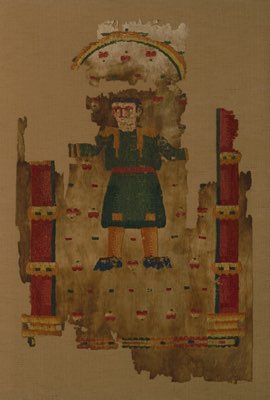
Temple hanging
13th century (bodhisattva), 18th–19th century (hanging)
- Medium
- Medium: silk, metal threads, paper Technique: the bodhisattva is needle looping technique; the hanging is made from various woven fabrics sewn together
- Classification
- Altar and altar component coverings and hangings
- Dimensions
- H x W: 64.5 x 20 cm (25 3/8 x 7 7/8 in.)
- Culture
- China
- Museum
- Smithsonian Institution, Cooper Hewitt, Smithsonian Design Museum
- Credit line
- Museum purchase from Smithsonian Regents Collections Acquisition Fund
- Rights
- CC0 (Smithsonian Open Access), as the museum states it.
- Who can see it
- Little Ones profiles and older: it shows gentle subjects for the very young. How works are placed
View at the Smithsonian Institution
About this work
The central figure is a Bodhisattva made by needle looping in the 13th century. The figure was later sewn to a ground of Chinese light blue silk satin with a gold pattern of chrysanthemums on a curving vine. The standard is made from various woven silk and metallic brocades, sewn in tab-like forms to surround the Bodhisattva. A silk tassel finishes the bottom.