Window mode follows your eyes with your camera, in this browser only: no picture or position leaves your device.
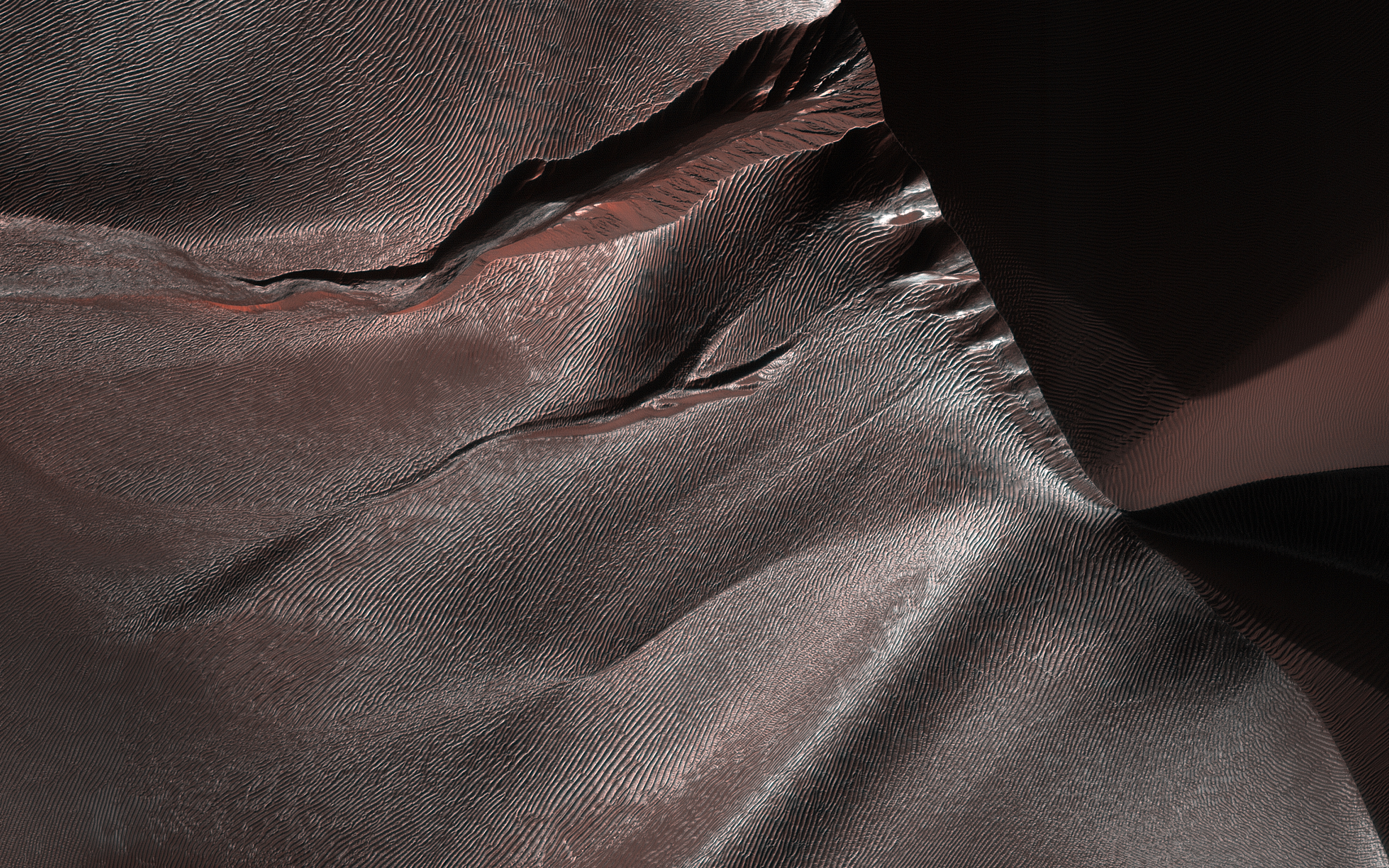
PIA22349 – Gullies of Matara Crater
NASA/JPL-Caltech/Univ. of Arizona
4 February 2018 (published 2 April 2018)
- Classification
- Photograph
- Museum
- Wikimedia Commons
- Credit line
- This image or video was catalogued by Jet Propulsion Laboratory of the United States National Aeronautics and Space Administration (NASA) under Photo ID: PIA22349.
- Rights
- Public domain, as the museum states it.
- Who can see it
- Teens profiles and older: its subject is for older viewers (war, death, the Passion, drink or the like). How works are placed
About this work
Gullies on Martian sand dunes, like these in Matara Crater, have been very active, with many flows in the last ten years. The flows typically occur when seasonal frost is present.
In this image from NASA's Mars Reconnaissance Orbiter we see frost in and around two gullies, which have both been active before. (View this observation to see what these gullies looked like in 2010.) There are no fresh flows so far this year, but HiRISE will keep watching.
The map is projected here at a scale of 50 centimeters (19.7 inches) per pixel. [The original image scale is 50.3 centimeters (19.8 inches) per pixel (with 2 x 2 binning); objects on the order of 151 centimeters (59.4 inches) across are resolved.] North is up.
The University of Arizona, Tucson, operates HiRISE, which was built by Ball Aerospace & Technologies Corp., Boulder, Colorado. NASA's Jet Propulsion Laboratory, a division of Caltech in Pasadena, California, manages the Mars Reconnaissance Orbiter Project for NASA's Science Mission Directorate, Washington.