Window mode follows your eyes with your camera, in this browser only: no picture or position leaves your device.
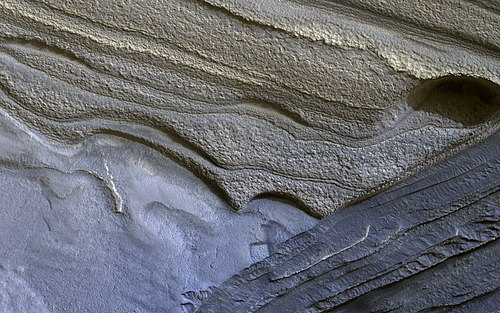
PIA11178 - The Contrasting Colors of Crater Dunes and Gullies
NASA/JPL-Caltech/Univ. of Arizona
15 January 2011 (published 2 February 2016)
- Classification
- Photograph
- Museum
- Wikimedia Commons
- Credit line
- This image or video was catalogued by Jet Propulsion Laboratory of the United States National Aeronautics and Space Administration (NASA) under Photo ID: PIA11178.
- Rights
- Public domain, as the museum states it.
- Who can see it
- Teens profiles and older: its subject is for older viewers (war, death, the Passion, drink or the like). How works are placed
About this work
Gullies are relatively common features in the steep slopes of crater walls, possibly formed by dry debris flows, movement of carbon dioxide frost, or perhaps the melting of ground ice.
This example shows a section of crater wall from the rocky crater rim at the far left of the image, down to the dark dusty dunes on the crater floor in the bottom right. (North is to the left.) The rock of the crater walls shows up deep orange, and the sandy deposits on the crater floor and the base of the crater walls appear blue. The sand isn’t really blue; the different colors in this image represent different material compositions.
The gullies in this image have two main sections: a scalloped alcove at the top of the gully (left/center), and defined channel sections further down the crater wall (right/center). Material from the alcove will have traveled down the channel to the crater floor. This normally forms a third section to a typical gully, a debris fan. Fans commonly visible at the base of gullies are not obvious in this example however, as the wind blown sediments (blue) have covered the crater floor after gully formation.
The University of Arizona, Tucson, operates HiRISE, which…