Window mode follows your eyes with your camera, in this browser only: no picture or position leaves your device.
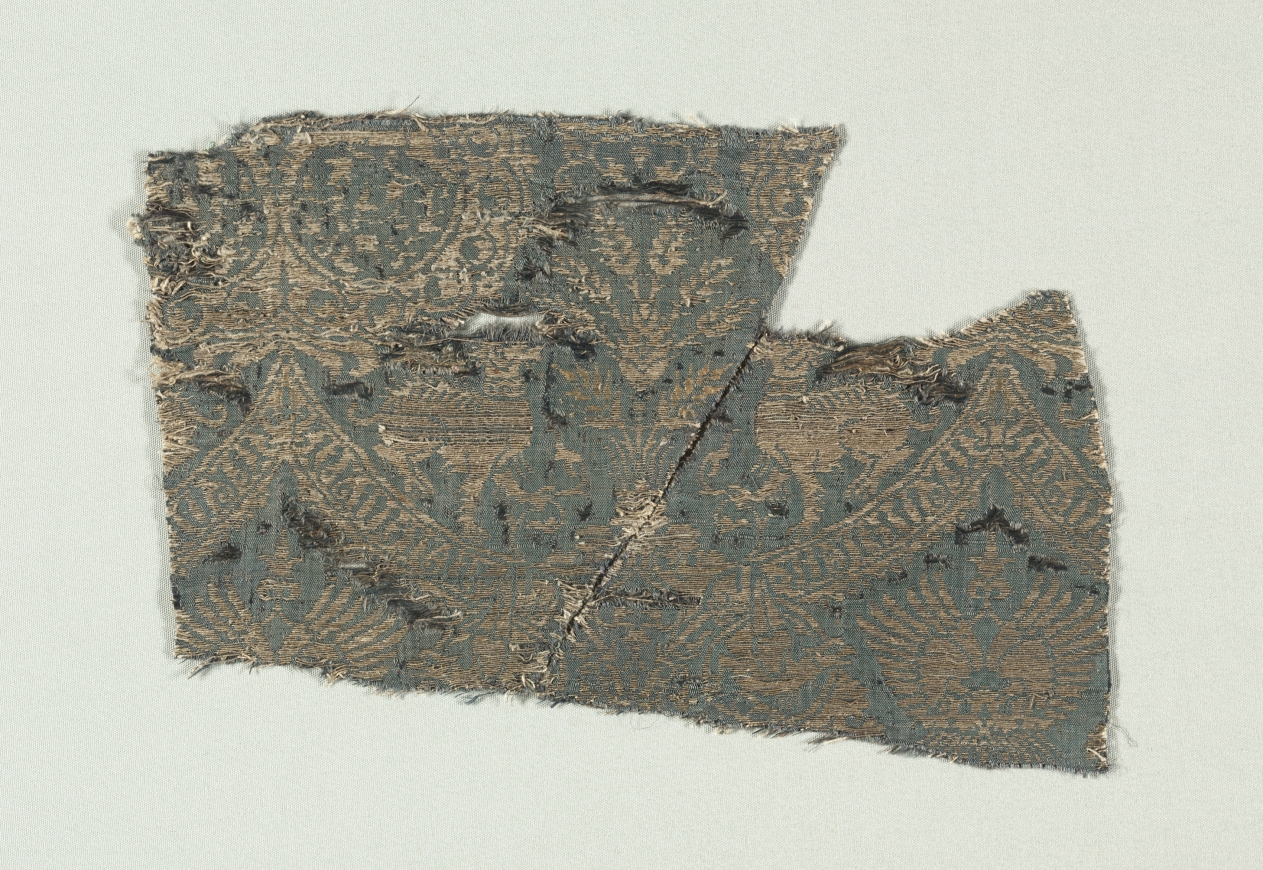
Silk with Dogs and Arabic Script in Swaying Bands
1370–1400
- Medium
- silk and silver thread; a combination of two weaves, 2/1 twill and 1/5 twill (lampas)
- Classification
- Textile
- Dimensions
- Overall: 22.2 x 30.5 cm (8 3/4 x 12 in.); Mounted: 46.4 x 69.2 cm (18 1/4 x 27 1/4 in.)
- Culture
- Italy, last third of 14th century
- Museum
- Cleveland Museum of Art, Textiles
- Credit line
- Dudley P. Allen Fund
- Rights
- Public domain (CC0), as the museum states it.
- Who can see it
- Little Ones profiles and older: it shows gentle subjects for the very young. How works are placed
View at the Cleveland Museum of Art
About this work
Arabic script was included in many Italian silk patterns during the 1300s and early 1400s. Usually a few unintelligible but decorative Arabic letters were repeated in the design, but here, the pseudo-Arabic script is prominently displayed in the scalloped bands that support trefoil palmettes. Dogs and birds are incorporated into the pattern in an Italian fashion. During the 1300s and 1400s, Arabic script was featured in luxurious silks woven in Islamic territories, where it symbolized royal power. Spain, Egypt, and to a lesser extent the former Islamic territory of Sicily all produced examples that could have influenced the international silk style created by Italian silk designers. In addition, weavers may also have reinforced the fashion; they migrated from Sicily to the silk-weaving city of Lucca and subsequently to Venice. In Italian painting, pseudo-Arabic script not only decorated the border of the Virgin's mantle, but it was also repeated in silks displayed in the backgrounds.


