Window mode follows your eyes with your camera, in this browser only: no picture or position leaves your device.
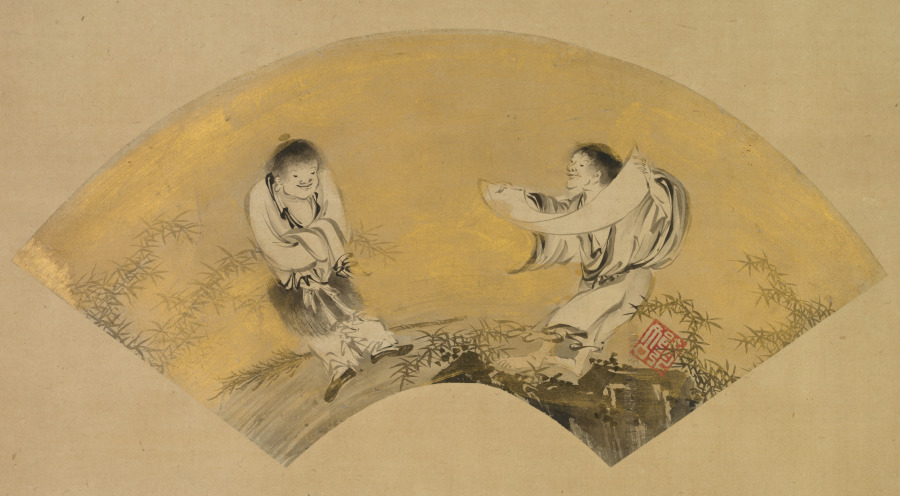
Hanshan and Shide (Kanzan and Jittoku)
Shikibu Terutada (Japanese, active mid-1500s)
mid-1500s
- Medium
- Fan-shaped painting mounted as hanging scroll; ink and gold on paper
- Classification
- Painting
- Dimensions
- Painting: 25 x 49.7 cm (9 13/16 x 19 9/16 in.); Mounted: 124.2 x 68.4 cm (48 7/8 x 26 15/16 in.)
- Culture
- Japan, Muromachi period (1392–1573)
- Museum
- Cleveland Museum of Art, Japanese Art
- Credit line
- Gift from the Collection of George Gund III
- Rights
- Public domain (CC0), as the museum states it.
- Who can see it
- Teens profiles and older: its museum says too little about what it shows to place it for younger viewers. How works are placed
View at the Cleveland Museum of Art
About this work
These three fan-shaped paintings, now mounted as individual hanging scrolls, were once part of a set of 20 mounted on a folding screen. They portray the Chinese subjects, from left to right, of the scholar-official Pan Lang, Hanshan reciting his poetry to Shide, and a duck in flight above reeds. Pan Lang grew so fond of the mountain in his place of exile that when he was ordered back to the capital, he rode backward on his donkey so he could see it until it receded into the distance. Hanshan and Shide worked in the kitchen of a Zen monastery, but were actually reincarnations of the bodhisattvas Manjushri and Samantabhadra. The combination of a mandarin duck and reeds may have signified a level of attainment in Chinese civil service exams. All three paintings bear the seal of the Kantobased artist Shikibu Terutada. Shikibu was familiar with Kano school painting, but he also modeled his early style after that of the prominent Kanto-based Kenkō Shōkei (active about 1470–after 1523).