Window mode follows your eyes with your camera, in this browser only: no picture or position leaves your device.
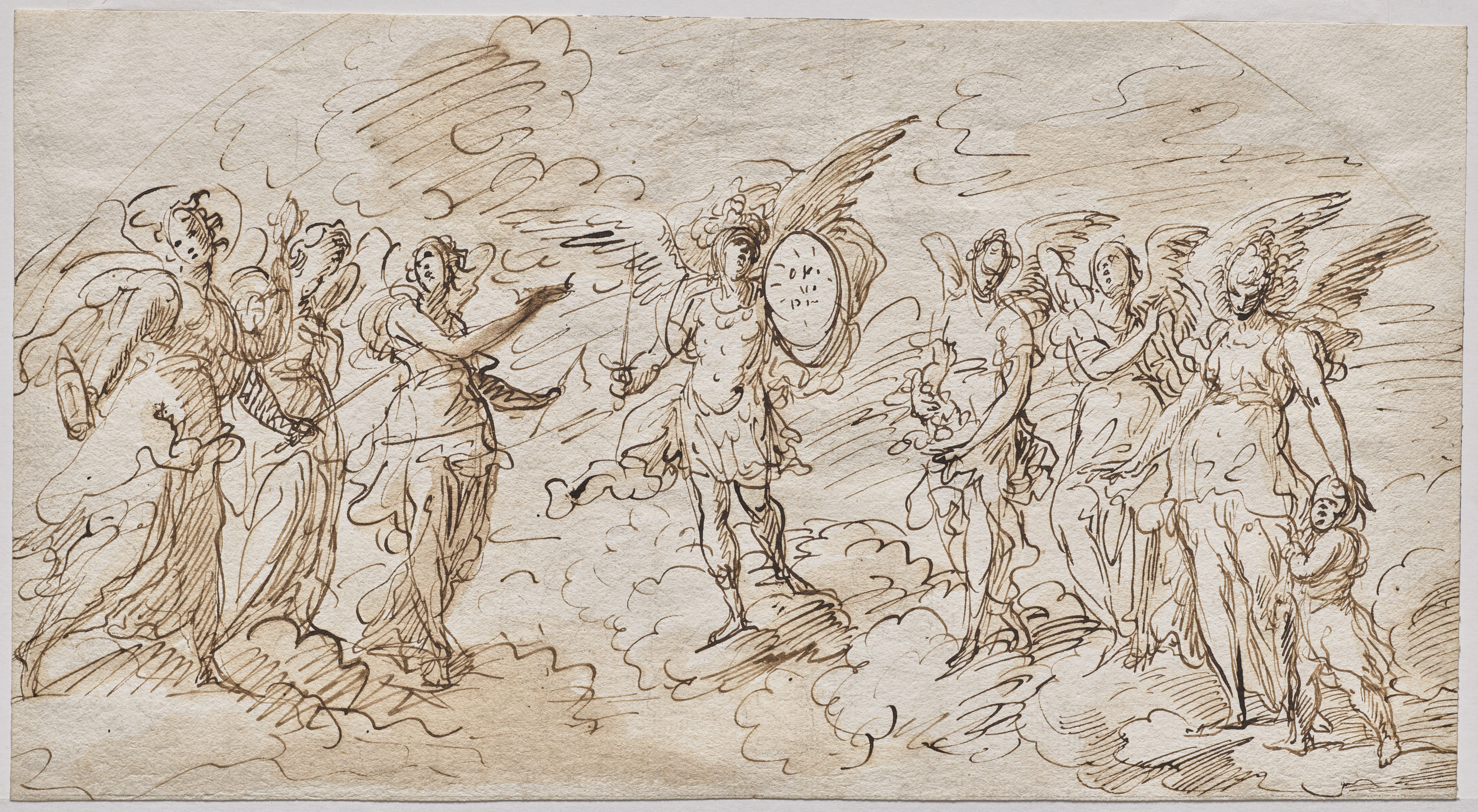
The Seven Archangels (recto)
Massimo Stanzione (Italian, 1585–1656)
c. 1620s
- Medium
- Pen and brown ink, brown wash, traces of black chalk (recto)
- Classification
- Drawing
- Dimensions
- Sheet: 9.5 x 35.8 cm (3 3/4 x 14 1/8 in.)
- Culture
- Italy
- Museum
- Cleveland Museum of Art, Drawings
- Credit line
- Purchase from the J. H. Wade Fund
- Rights
- Public domain (CC0), as the museum states it.
- Who can see it
- Teens profiles and older: its museum says too little about what it shows to place it for younger viewers. How works are placed
View at the Cleveland Museum of Art
About this work
Massimo Stanzione worked in the Spanish-held Kingdom of Naples, where, during the 17th century, painting was characterized by dramatic expression, emphatic naturalism, and intense chiaroscuro derived from the profound influence of Caravaggio (1571-1610). Stanzione, however, was known in the city as one of the main purveyors of a more classical style, a kind of antithesis to the passion and drama of such Neapolitan painters as Jusepe de Ribera. This drawing relates directly to a painting Stanzione made depicting the seven archangels at the Monasterio de la Descalzas Reales in Madrid. The iconography of the seven archangels was a regional focus of devotion in the Neapolitan kingdom, and in Spain, where the cult of the “Seven Angelic Princes” had been promoted by the 16th-century Sicilian friar, Antonio Del Duca (1491-1564).