Window mode follows your eyes with your camera, in this browser only: no picture or position leaves your device.
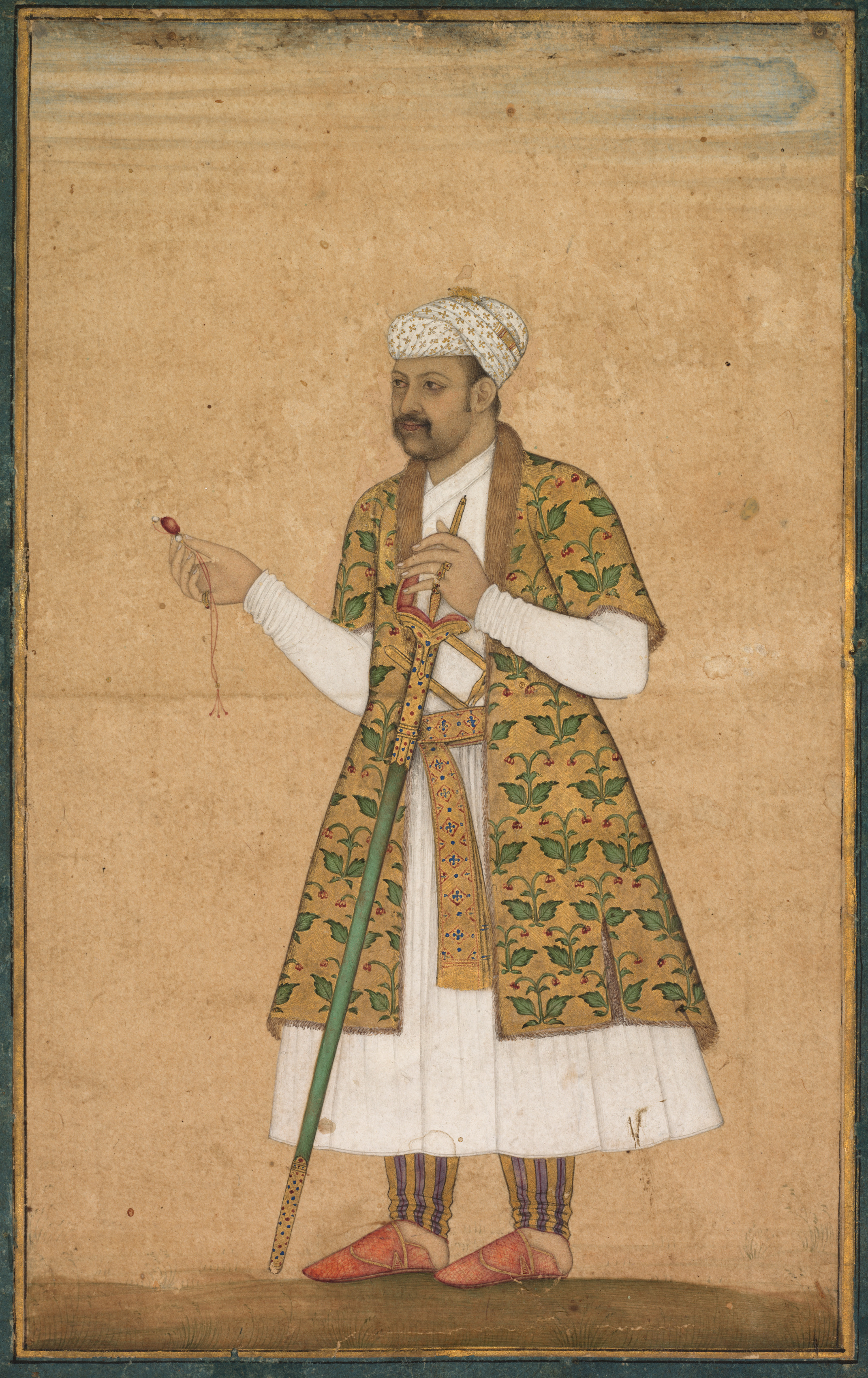
A Courtier, Possibly Khan Alam, Holding a Spinel and a Deccan Sword
attributed to Govardhan (Indian, active c.1596–1645)
calligrapher Abd al-Rahim, the Anbarin-Qalam (Indian, active c. 1590–1630)
c. 1605–1610
- Medium
- gum tempera, ink, and gold on paper, text on verso
- Classification
- Painting
- Dimensions
- Page: 17.8 x 12.5 cm (7 x 4 15/16 in.)
- Culture
- Mughal India
- Museum
- Cleveland Museum of Art, Indian and Southeast Asian Art
- Credit line
- Gift in honor of Madeline Neves Clapp; Gift of Mrs. Henry White Cannon by exchange; Bequest of Louise T. Cooper; Leonard C. Hanna Jr. Fund; From the Catherine and Ralph Benkaim Collection
- Rights
- Public domain (CC0), as the museum states it.
- Who can see it
- Teens profiles and older: its museum says too little about what it shows to place it for younger viewers. How works are placed
View at the Cleveland Museum of Art
About this work
According to Akbar's court historian, the emperor ordered likenesses to be taken of the grandees of his realm. "An immense album was thus formed: those that have passed away have received a new life, and those who are still alive have immortality promised them." Akbar's son and successor, Jahangir (reigned 1605-27), continued the tradition of commissioning works of lifelike portraiture for inclusion in imperial albums. This courtier wears an opulent fur-trimmed, fringed velvet coat over his belted white tunic and striped pants-the typical Mughal dress derived from their roots among the nomadic horse-riding people of Central Asia. The artist has reveled in creating the soft textures of the facial hair, fur and fabrics. He holds a ruby-like gemstone called a spinel, which was prized among the Mughals for its talismanic properties of protection during battle.