Window mode follows your eyes with your camera, in this browser only: no picture or position leaves your device.
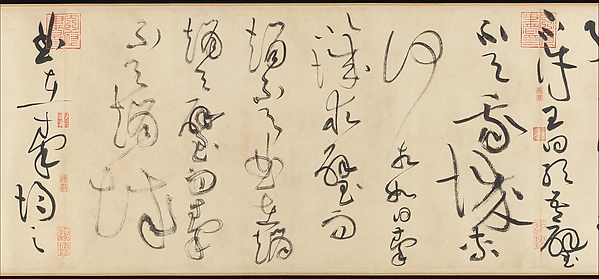
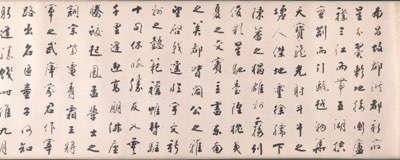
Poems and Pictures of the Eight Views of Xiao-Xiang
Unkoku Tōgan (Japanese, 1547–1618)
calligrapher Inkei Gentetsu (Japanese, 1562–1612)
1605–12
- Medium
- Handscroll; ink on paper
- Classification
- Painting
- Dimensions
- 40.3 x 657.8 cm (15 7/8 x 259 in.)
- Culture
- Japan, Momoyama period (1573–1615)
- Museum
- Cleveland Museum of Art, Japanese Art
- Credit line
- Leonard C. Hanna Jr. Fund
- Rights
- Public domain (CC0), as the museum states it.
- Who can see it
- Tweens profiles and older: its subjects are known and suit older children. How works are placed
View at the Cleveland Museum of Art
About this work
Unkoku Tōgan brushed these scenes using the splashed-ink technique associated in Japan with the Chinese monk Yujian Ruofen (active late 1200s). Xiao-Xiang refers to the region in present-day Hunan province, where the Xiang River and its tributaries converge. Each of the eight views evokes a time of day or season. The earliest surviving series of Xiao-Xiang paintings is by Wang Hong (active mid-1100s), but textual evidence tells us the theme appears earlier. It was later adopted in Japan and Korea, as seen here. The poems were inscribed by Inkei Gentetsu, the third abbot of the Rinzai Zen temple Tōshunji, Japan