Window mode follows your eyes with your camera, in this browser only: no picture or position leaves your device.
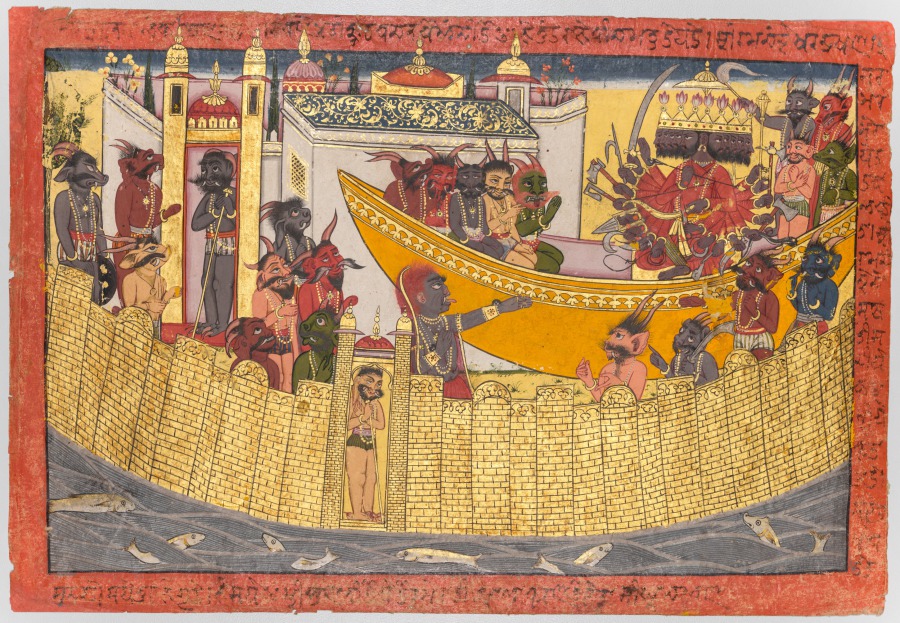
Shurpanakha demands vengeance, from the "Shangri" Ramayana
c. 1700
- Medium
- Gum tempera, ink, and gold on paper
- Classification
- Painting
- Dimensions
- Painting: 18.4 x 28.9 cm (7 1/4 x 11 3/8 in.); Page: 21.6 x 31.8 cm (8 1/2 x 12 1/2 in.)
- Culture
- Northern India, Pahari kingdoms
- Museum
- Cleveland Museum of Art, Indian and Southeast Asian Art
- Credit line
- Purchase and partial gift from the Catherine and Ralph Benkaim Collection; Severance and Greta Millikin Purchase Fund
- Rights
- Public domain (CC0), as the museum states it.
- Who can see it
- Teens profiles and older: its museum says too little about what it shows to place it for younger viewers. How works are placed
View at the Cleveland Museum of Art
About this work
In a dramatic climax, the artists introduce the demon king, Ravana (the Howler), archvillain of the Ramayana. He has 10 crowned heads and 20 arms. He grasps a different deadly weapon in each hand; they reveal his supreme powers. The demon Shurpanakha’s nose and ears are healing, but her desire for revenge is stronger than ever. She gestures emphatically at her brother Ravana, urging him to find a way to destroy Rama, perhaps by kidnapping Rama’s wife. More gold has been lavished on this painting than any other known from the “Shangri” Ramayana, suggesting that it is meant to stand out as a scene of primary importance.