Window mode follows your eyes with your camera, in this browser only: no picture or position leaves your device.
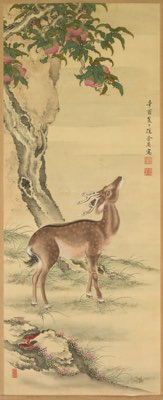
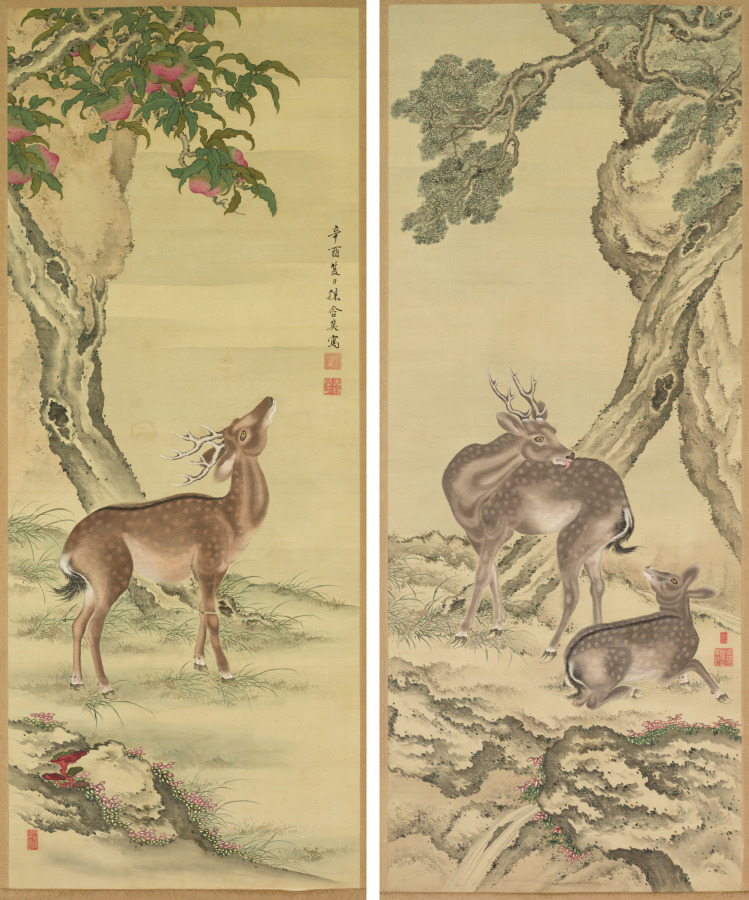
Symbols of Longevity: Deer under Peach and Pine
Toda Tadanaka (Japanese, 1761–1823)
1801
- Medium
- Pair of hanging scrolls; ink and color on silk (ivory roller ends)
- Classification
- Painting
- Dimensions
- Overall: 197.8 x 68.7 cm (77 7/8 x 27 1/16 in.); Painting only: 135 x 54 cm (53 1/8 x 21 1/4 in.); Scroll: 197.8 x 74.6 cm (77 7/8 x 29 3/8 in.)
- Culture
- Japan, Edo period (1615–1868)
- Museum
- Cleveland Museum of Art, Japanese Art
- Credit line
- Gift of the Kelvin Smith Family
- Rights
- Public domain (CC0), as the museum states it.
- Who can see it
- Little Ones profiles and older: it shows gentle subjects for the very young. How works are placed
View at the Cleveland Museum of Art
About this work
This pair of hanging scrolls is replete with images symbolizing longevity. Peaches, associated with immortality, hang in abundance from a tree in the left scroll, while pines, known for being eternally green, twist together in the right scroll. Beneath the trees stand two bucks, one of whom gazes at a doe seated on the ground as he licks his coat. Medicine made from deer antlers is said to promote health. Mushrooms, in bright red and green, seen in the left scroll, are said to confer immortality upon those who eat them, and the small waterfall in the right scroll speaks to the infinite flexibility and abundance flowing through life. Toda Tadanaka, the son of the ruler of Noto province and a military leader himself, trained with trained with Mori Ransai (1740-1801), a painter known for colorful bird-and-flower compositions in the style of Shen Nanping. The style is more generally referred to as the Nagasaki style, indicating the port city in which a number of Chinese painters were active in the Edo period (1615-1868).