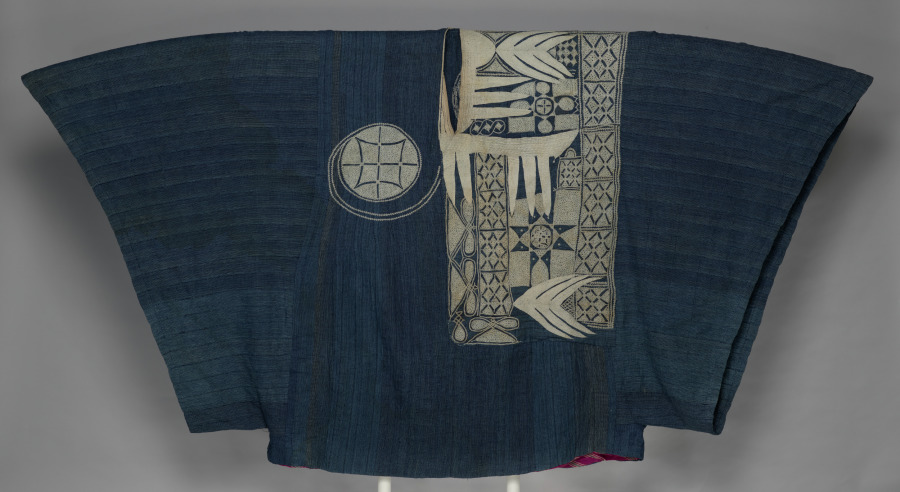
Prestige robe (riga)
late 1800s–by 1910
- Medium
- Cotton, silk, and indigo
- Classification
- Garment
- Dimensions
- Overall: 120 x 226 cm (47 1/4 x 89 in.)
- Culture
- Africa, West Africa, Nigeria, probably Hausa-style or Nupe-style weavers and embroiders
- Museum
- Cleveland Museum of Art, African Art
- Credit line
- Alma Kroeger Fund
- Rights
- Public domain (CC0), as the museum states it.
- Who can see it
- Teens profiles and older: its museum says too little about what it shows to place it for younger viewers. How works are placed
View at the Cleveland Museum of Art
About this work
Elite Nigerian men wore voluminous status garments variously called riga (Hausa), agbádá (Yorùbá), boubou (French), or mbubb (Wolof). Punctuated with white silk, this strip-woven riga’s inky blue was achieved by repeatedly dipping threads into indigo dye before weaving them. Embroiderers were often skilled Arabic calligraphers; the motifs here once had protective Islamic symbolism. The front pocket features the pointed “eight knives” (aska takwas) and a leaf (gambiya) associated with the Nupe peoples. At back, a spiral leads the wearer toward God. Magenta silk imported via trans-Saharan routes lines the hem. Rigan historically held transcultural appeal; today, they are pan-Nigerian male national dress.