Window mode follows your eyes with your camera, in this browser only: no picture or position leaves your device.
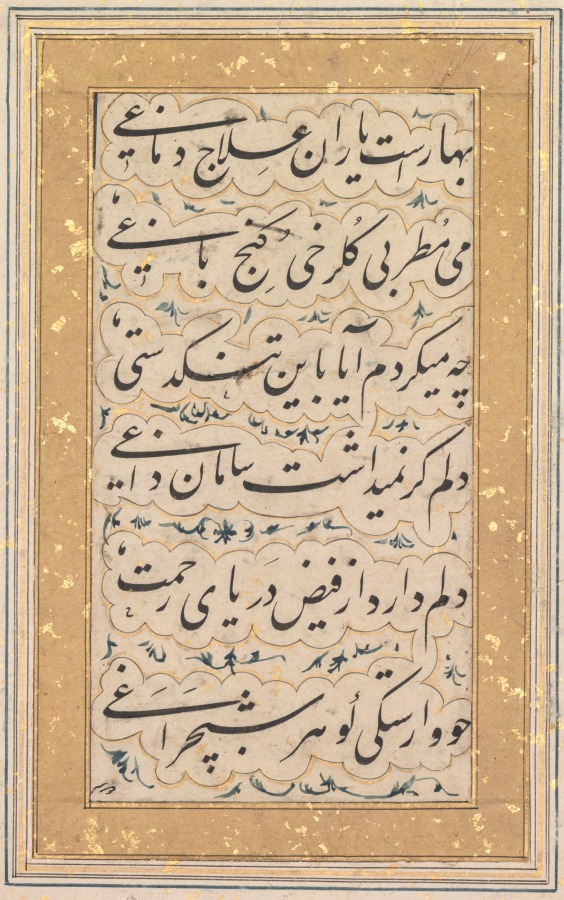
Calligraphy
c. 1640–60
- Medium
- Gum tempera, ink, and gold on paper
- Classification
- Painting
- Dimensions
- Page: 40.5 x 28.9 cm (15 15/16 x 11 3/8 in.)
- Culture
- Western India, Deccan
- Museum
- Cleveland Museum of Art, Indian and Southeast Asian Art
- Credit line
- Gift in honor of Madeline Neves Clapp; Gift of Mrs. Henry White Cannon by exchange; Bequest of Louise T. Cooper; Leonard C. Hanna Jr. Fund; From the Catherine and Ralph Benkaim Collection
- Rights
- Public domain (CC0), as the museum states it.
- Who can see it
- Tweens profiles and older: its subjects are known and suit older children. How works are placed
View at the Cleveland Museum of Art
About this work
The text of the poem praises the season of spring, with mystical undertones. The Persian verses are written from right to left in the cursive form of Arabic script known as nasta‘liq. "It is springtime friends! Time to nurse the carnal wants: Wine, a minstrel, a pretty face, a secluded corner in a garden. What would I have done given my lack of means, If my heart did not have a cure for searing longings? My heart derives from the bounteous Sea of Compassion Its self-abnegating otherworldliness, an ever-radiant night glowing gem." The poem may be related to the painting of the African musician on the other side, subtly perpetuating the stereotypical association of African men with lustful desires, music, and dance.