Window mode follows your eyes with your camera, in this browser only: no picture or position leaves your device.
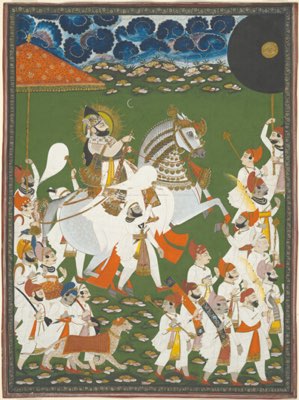
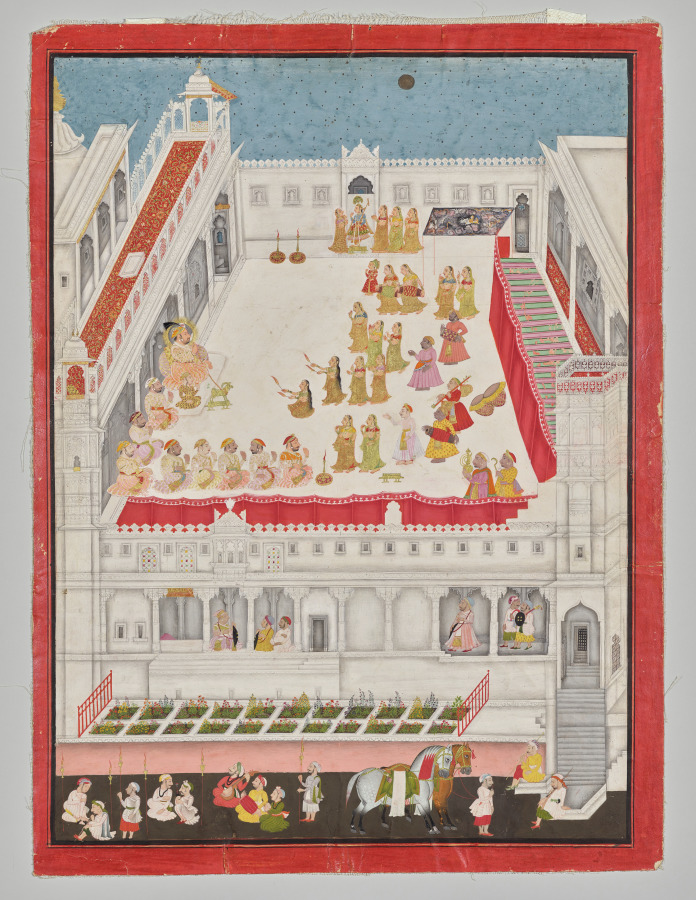
Maharana Jagat Singh Attending the Raslila
attributed to Jai Ram (Indian, active 1710–40)
and/or Jiva (Indian, active mid-1700s)
1736
- Medium
- Gum tempera, gold, and silver on paper
- Classification
- Painting
- Dimensions
- Sheet: 67.5 x 49 cm (26 9/16 x 19 5/16 in.)
- Culture
- Northwestern India, Rajasthan, Mewar, Udaipur, 18th century
- Museum
- Cleveland Museum of Art, Indian and Southeast Asian Art
- Credit line
- Gift of Maxeen and John Flower in honor of Dr. Stanislaw Czuma
- Rights
- Public domain (CC0), as the museum states it.
- Who can see it
- Teens profiles and older: its museum says too little about what it shows to place it for younger viewers. How works are placed
View at the Cleveland Museum of Art
About this work
To celebrate the New Year festival of Diwali, dancers reenact the life story of the Hindu god Krishna in a palace courtyard by candlelight under the full moon. The king, a vassal of the Mughal emperor, sits with the halo of divine sanction for his rule at the left of the courtyard, smoking from a golden goat-shaped hookah, with his young son and heir at his side. At the top of the composition, a dancer dressed in blue with a peacock-feather crown plays the part of Krishna. In the upper right corner, a canopy painted with swirling storm clouds stands for the rainstorm sent by the jealous king of the gods, who is shown in the middle of the canopy with his consort and mount, the elephant with seven trunks. Guards and grooms in the foreground entertain themselves with music while they wait with the horses of visiting nobles. The formal geometric gardens, playful use of perspective, and individualized portraiture indicate the selective adoption of the styles and sensibilities of the imperial Mughal court in the paintings from this large-format series.