Window mode follows your eyes with your camera, in this browser only: no picture or position leaves your device.
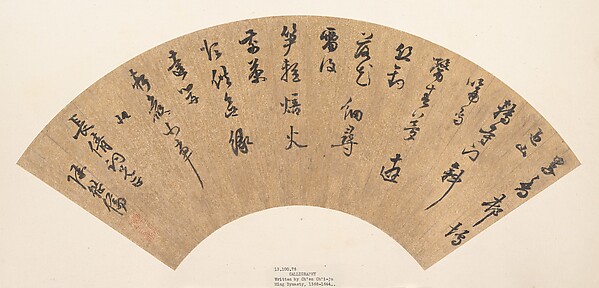
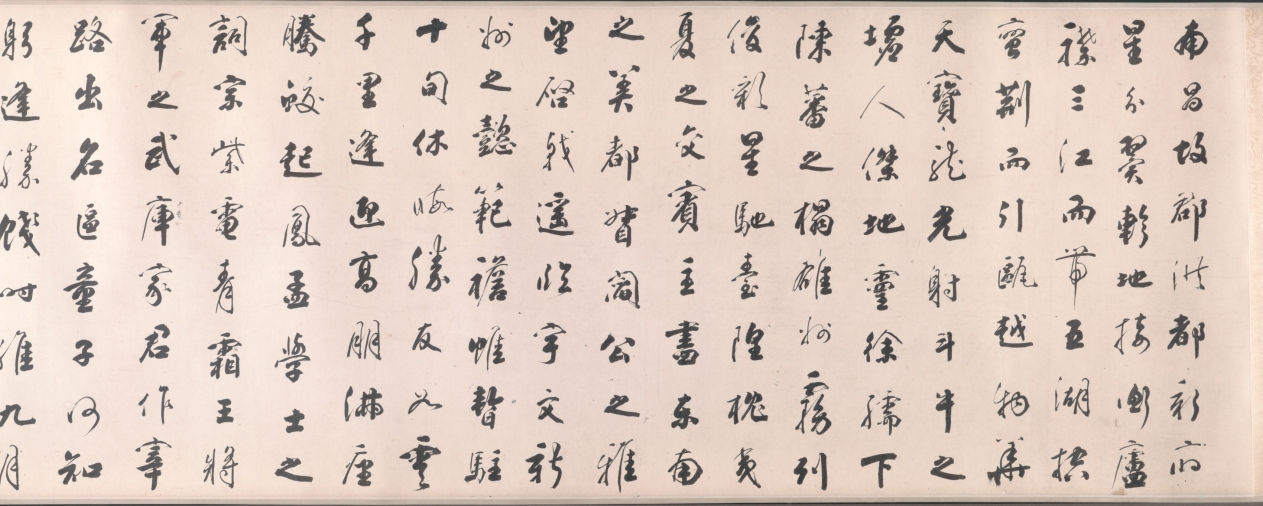
Four Poems: Calligraphy in Cursive Script (xingshu)
Chen Jiru (Chinese, 1558–1639)
1500s-1600s
- Medium
- handscroll; ink on gold speckled paper
- Classification
- Calligraphy
- Dimensions
- Calligraphy section: 27 x 195 cm (10 5/8 x 76 3/4 in.)
- Culture
- China, Ming dynasty (1368–1644)
- Museum
- Cleveland Museum of Art, Chinese Art
- Credit line
- Gift of Dr. Roger Y.K. and Mrs. Evangeline C. Hsu, Dr. Daphne T. Hsu, and Dr. Jeffrey T. Hsu in honor of Dr. Ju-hsi Chou
- Rights
- Public domain (CC0), as the museum states it.
- Who can see it
- Tweens profiles and older: its subjects are known and suit older children. How works are placed
View at the Cleveland Museum of Art
About this work
Written in graceful calligraphy with well-composed characters, the artist communicates his thoughts and state of mind in four poems. Characters written in dark, thick strokes convey rhythm, and indicate the moment after the writer had paused to recharge his brush with ink. Chen Jiru was a native of Huating (modern Shanghai). His calligraphy style resembles that of his friend, influential calligrapher Dong Qichang (1555–1636). Unlike Dong, Chen did not pursue government service: he burned his Confucian robes, declined a summons to serve at court, and immersed himself in literature, calligraphy, and painting.