Window mode follows your eyes with your camera, in this browser only: no picture or position leaves your device.
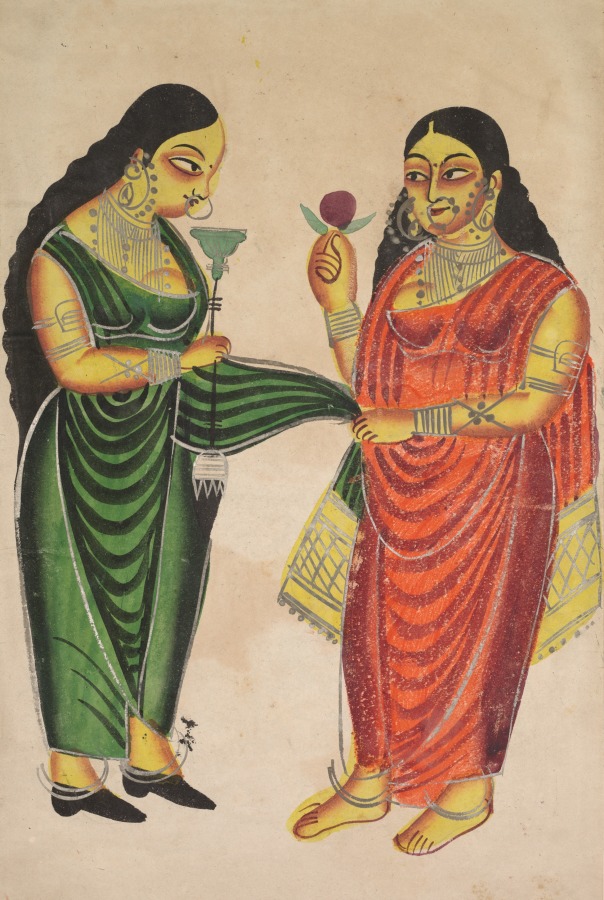
Maid bringing a hookah to a lady (recto), from a Kalighat album
c. 1890
- Medium
- Gum tempera, graphite, ink, and tin on paper
- Classification
- Painting
- Dimensions
- Secondary Support: 48.6 x 30.1 cm (19 1/8 x 11 7/8 in.); Painting only: 45.8 x 27.5 cm (18 1/16 x 10 13/16 in.)
- Culture
- Eastern India, Bengal, Kolkata, Kalighat
- Museum
- Cleveland Museum of Art, Indian and Southeast Asian Art
- Credit line
- Gift of William E. Ward in memory of his wife, Evelyn Svec Ward
- Rights
- Public domain (CC0), as the museum states it.
- Who can see it
- Tweens profiles and older: its subjects are known and suit older children. How works are placed
View at the Cleveland Museum of Art
About this work
Kalighat paintings reflect the time and context in which they were created. Kalighat painters used their medium to offer penetrating and insightful critiques of British-influenced Indians as well as the British themselves through satires and caricatures. Newly rich Bengali native Indian clerks (babus) aspired to dress and behave like their British masters, and Kalighat painters taunted them for this.
The maid, dressed in green, holds a hookah in her right hand. The lady in red is likely a fashionable high society concubine or prostitute known and depicted at this time as hookah-smoking, makeup-wearing, paan- (betel leaf with areca nut and lime paste) chewing hussies. The wealth created by the East India Company made it possible for Bengali babu dandies to have concubines and pay for prostitutes.