Window mode follows your eyes with your camera, in this browser only: no picture or position leaves your device.
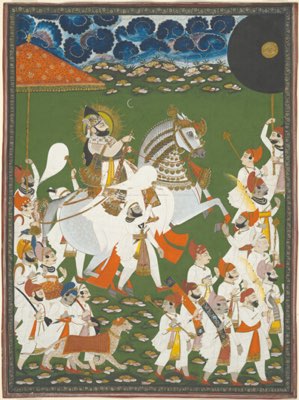
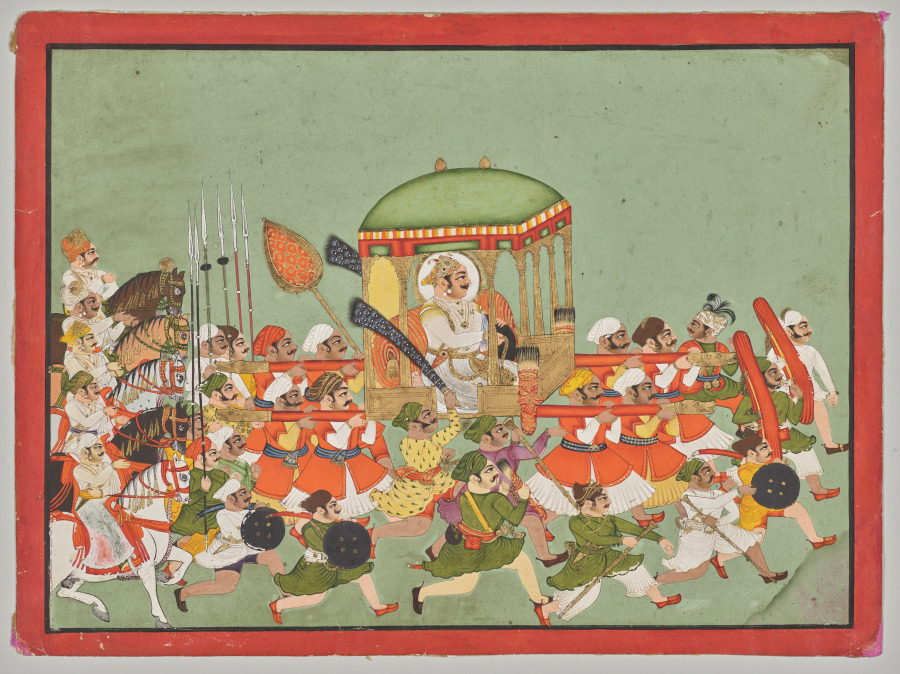
Maharao Chattar Sal (reigned 1758–64) of Kota in a Palanquin
c. 1760
- Medium
- Gum tempera and gold on paper
- Classification
- Painting
- Dimensions
- Overall: 28.3 x 39.2 cm (11 1/8 x 15 7/16 in.); with borders: 31.6 x 42.7 cm (12 7/16 x 16 13/16 in.)
- Culture
- Northwestern India, Rajasthan, Kota
- Museum
- Cleveland Museum of Art, Indian and Southeast Asian Art
- Credit line
- Bequest of Mrs. Severance A. Millikin
- Rights
- Public domain (CC0), as the museum states it.
- Who can see it
- Teens profiles and older: its museum says too little about what it shows to place it for younger viewers. How works are placed
View at the Cleveland Museum of Art
About this work
The king sits in his litter with a sun and moon disk behind his head, emphasizing the light of divine sanction for his rule. His power and grandeur seem to inspire his attendants to stride with effortless enthusiasm. Symbols of royalty abound in his retinue: cavaliers on horseback, spear bearers, soldiers with swords and daggers, attendants with peacock-feather fans, and archers carrying bows draped in red and quivers full of arrows.
The small kingdom of Kota achieved independence in 1624, and its rulers, called rao (king) or maharao (great king) in the local dialect of Rajasthani, supported an atelier of artists at their court. Kota artists were known for dynamic and idealized portrayals of their rulers engaged in activities that emphasized the king’s supreme status.