Window mode follows your eyes with your camera, in this browser only: no picture or position leaves your device.
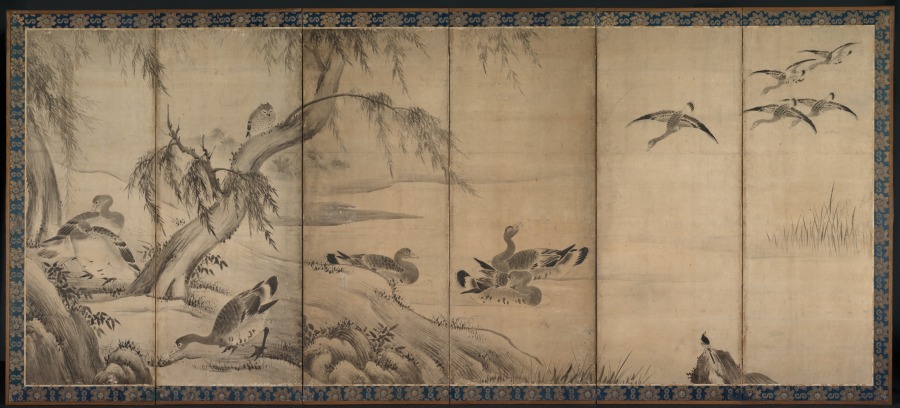
Wild Geese
Kano Sanraku (Japanese, 1559–1635)
late 1500s-early 1600s
- Medium
- pair of six-fold screens; ink on paper
- Classification
- Painting
- Dimensions
- Overall: 170.2 x 371.8 cm (67 x 146 3/8 in.); Painting only: 152 x 359 cm (59 13/16 x 141 5/16 in.)
- Culture
- Japan, Edo period (1615–1868)
- Museum
- Cleveland Museum of Art, Japanese Art
- Credit line
- Leonard C. Hanna Jr. Fund
- Rights
- Public domain (CC0), as the museum states it.
- Who can see it
- Little Ones profiles and older: it shows gentle subjects for the very young. How works are placed
View at the Cleveland Museum of Art
About this work
Depictions of geese usually appear as ink paintings in Japan during the 1200s. They later show up in the colorful landscapes of illustrated handscrolls. Such early ink renditions of the birds have long been associated with classical Chinese Zen painting and poetry, which was avidly admired and collected in medieval Japan. In the screens on display, the artist portrayed the waterfowl in a pastoral setting without reference to classical or religious themes. Such ordinary subjects were imbued with special meaning in 14th- and 15th-century Japan through associations with continental culture, Zen thought and poetry, and famous Chinese monk-painters whose painting techniques had become revered as visual emblems of Zen principles. The screens here reflect the continuation of that painting tradition in the late 1500s or early 1600s by the head of the most important studio in Kyoto. Sanraku also executed a number of colorful folding screen compositions, but here pays homage to the style of early Zen painting.