Window mode follows your eyes with your camera, in this browser only: no picture or position leaves your device.
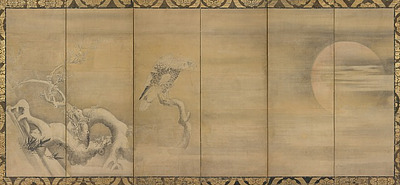
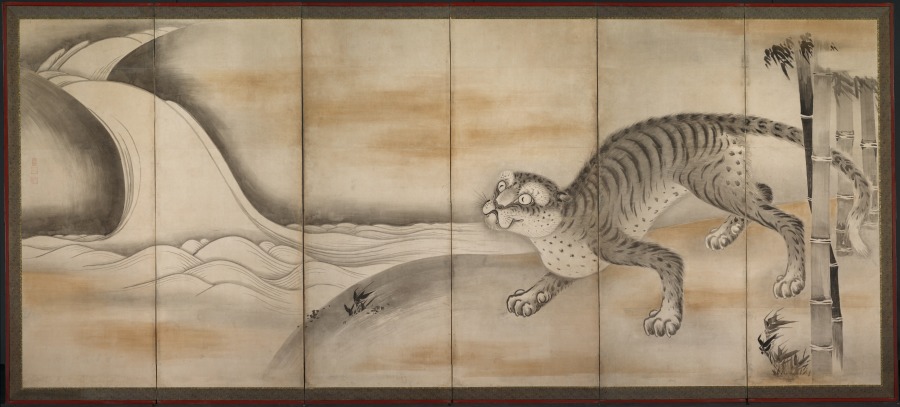
Tiger
attributed to Soga Nichokuan (Japanese)
early to mid-1600s
- Medium
- six-panel folding screen; ink, slight color, gold, and silver on paper
- Classification
- Painting
- Dimensions
- Painting only: 158.1 x 304.8 cm (62 1/4 x 120 in.); Including mounting: 173.4 x 377.2 cm (68 1/4 x 148 1/2 in.)
- Culture
- Japan, Edo period (1615–1868)
- Museum
- Cleveland Museum of Art, Japanese Art
- Credit line
- Leonard C. Hanna Jr. Fund
- Rights
- Public domain (CC0), as the museum states it.
- Who can see it
- Little Ones profiles and older: it shows gentle subjects for the very young. How works are placed
View at the Cleveland Museum of Art
About this work
A tiger looks upon a waterfall as it prowls out of a bamboo grove on this screen, and a dragon dives through clouds on the right. Tiger and dragon are traditional symbols of the balancing forces in the world, yin (the feminine aspect) and yang (the masculine aspect). This painting has a signature and seals, identifying it as a work by Soga Nichokuan, a painter thought to be from Sakai (near Osaka), and known primarily for his representations of hawk-eagles (kumataka).