Window mode follows your eyes with your camera, in this browser only: no picture or position leaves your device.
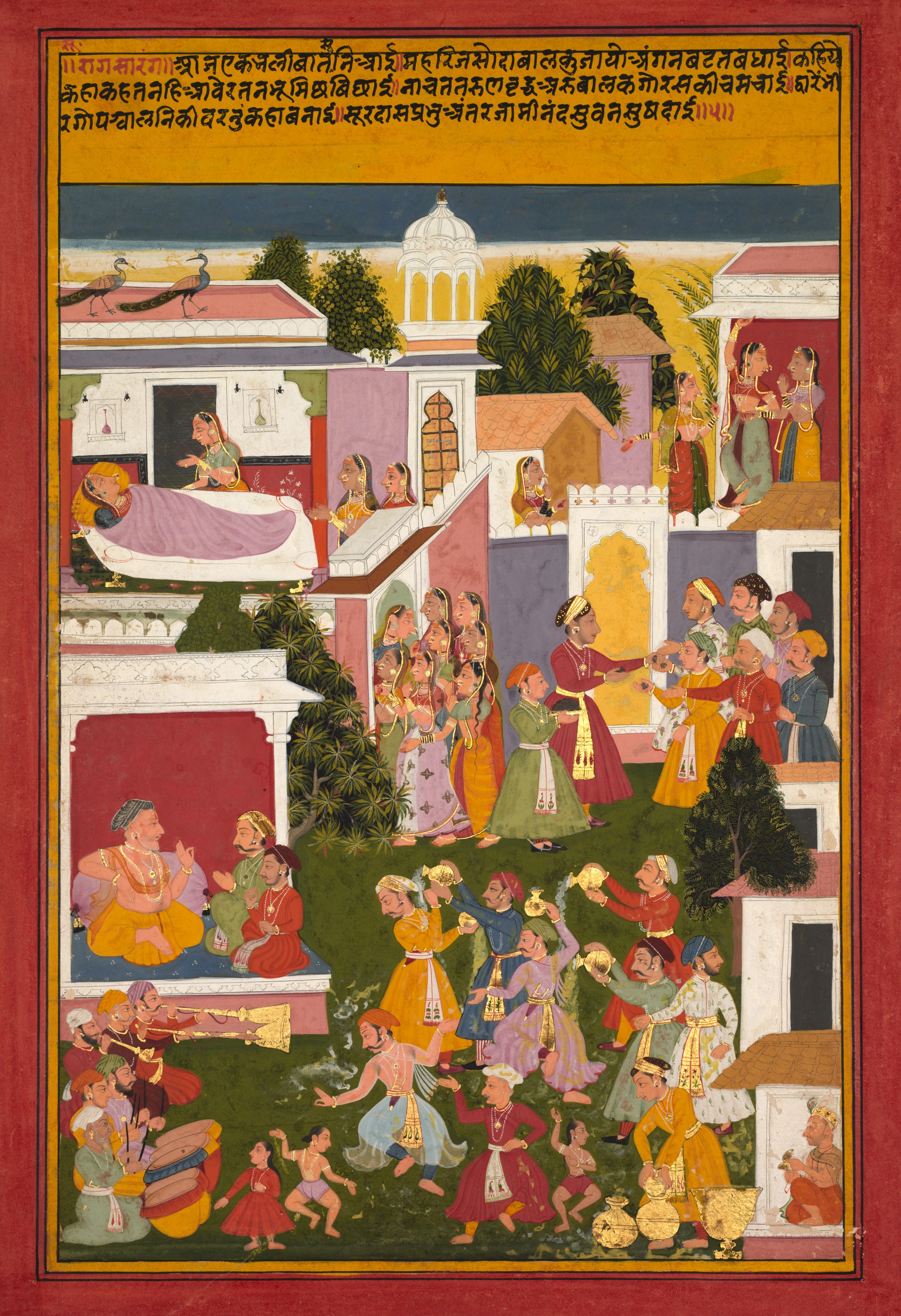
The Birth of Krishna, from a Sursagar of Surdas (Indian, c. 1480–1580)
1705–10
- Medium
- Gum tempera, ink, and gold on paper
- Classification
- Painting
- Dimensions
- Image: 33.6 x 22.2 cm (13 1/4 x 8 3/4 in.); Overall: 37 x 25.4 cm (14 9/16 x 10 in.); with mat: 49 x 36.3 cm (19 5/16 x 14 5/16 in.)
- Culture
- Northwestern India, Rajasthan, Rajput Kingdom of Mewar
- Museum
- Cleveland Museum of Art, Indian and Southeast Asian Art
- Credit line
- Edwin R. and Harriet Pelton Perkins Memorial Fund
- Rights
- Public domain (CC0), as the museum states it.
- Who can see it
- Tweens profiles and older: its subjects are known and suit older children. How works are placed
View at the Cleveland Museum of Art
About this work
The blind poet and Hindu saint Surdas (1578/79–c. 1581), a devotee of Krishna, is shown in the hut at the lower right corner playing cymbals to measure meter as he recites his poem, called Sursagar. Verse 5 is written at the top of the page, and the scenes of festivities surrounding the arrival of the newborn Krishna are depicted throughout the rest of the painting. His adoptive mother Yashoda lies with the infant in the chamber at the upper left. His dark skin led to his being named Krishna, meaning dark, and shown as blue. Women clamor at her door to see the baby, as the men of the village receive silver coins being distributed on behalf of Nanda, the village elder and Krishna’s adoptive father, who is seated at the left receiving two well-wishers. Below, men and children of the cowherd village celebrate by pouring pots of curds and ghee over each other and dancing to the sounds of horns and drums.