Window mode follows your eyes with your camera, in this browser only: no picture or position leaves your device.
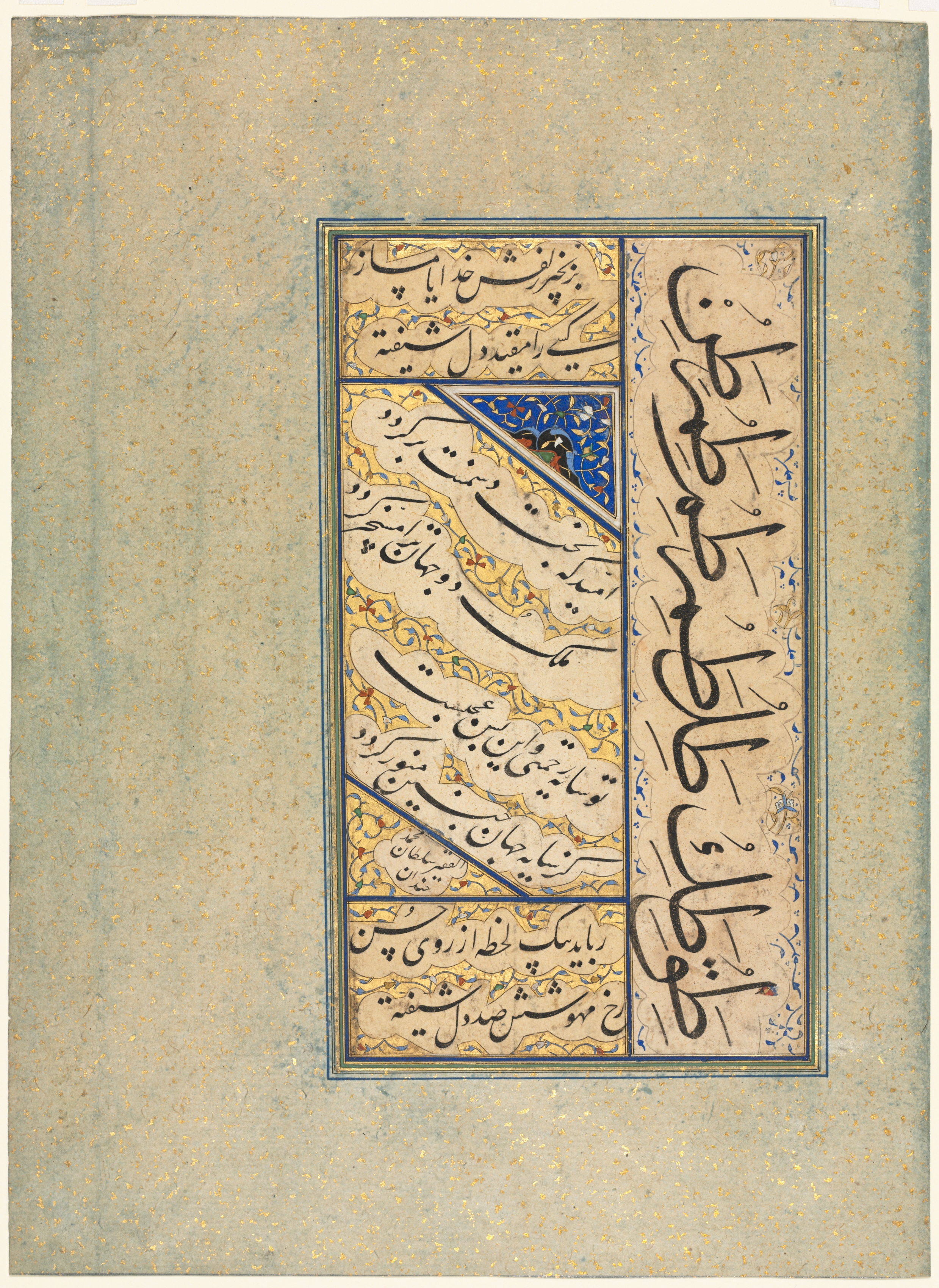
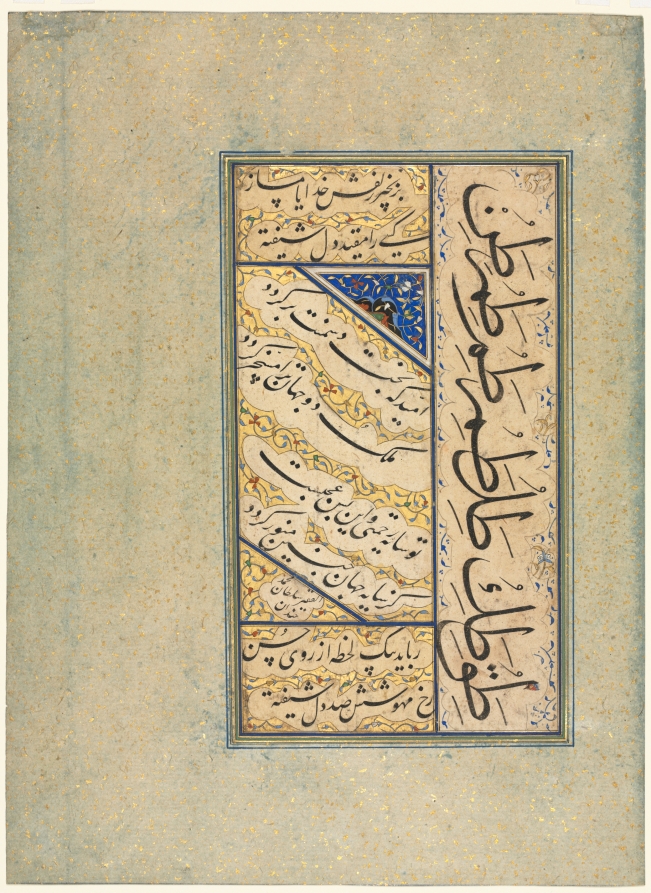
Persian Quatrains (Rubayi) and Calligraphic Exercises (recto)
Sultan Muhammad Khandan (Iranian, d. after 1550)
c. 1509–59
- Medium
- ink, gold, and opaque watercolor on paper
- Classification
- Manuscript
- Dimensions
- Sheet: 27.4 x 20 cm (10 13/16 x 7 7/8 in.); Text area: 18.7 x 10.9 cm (7 3/8 x 4 5/16 in.)
- Culture
- Afghanistan, Herat, Safavid period (1501–1722)
- Museum
- Cleveland Museum of Art, Islamic Art
- Credit line
- Gift of Mrs. Mehmed A. Simsar in memory of Dr. Mehmed A. Simsar
- Rights
- Public domain (CC0), as the museum states it.
- Who can see it
- Tweens profiles and older: its subjects are known and suit older children. How works are placed
View at the Cleveland Museum of Art
About this work
This page contains two quatrains—poems made up of four lines. The diagonally written text in the center of the page is a poem addressed to a ruler, expressing hope for his success and the downfall of his enemies. The second poem is split between the horizontal panels at the top and bottom of the page. This quatrain praises the beauty of the writer’s beloved, saying that “her moonlike face can steal away a hundred besotted hearts.” At the right are calligraphic exercises displaying letters of the alphabet and the virtuoso skill of the calligrapher Sultan Muhammad Khandan, who signed the page in the triangle at the lower left of the inner text block.