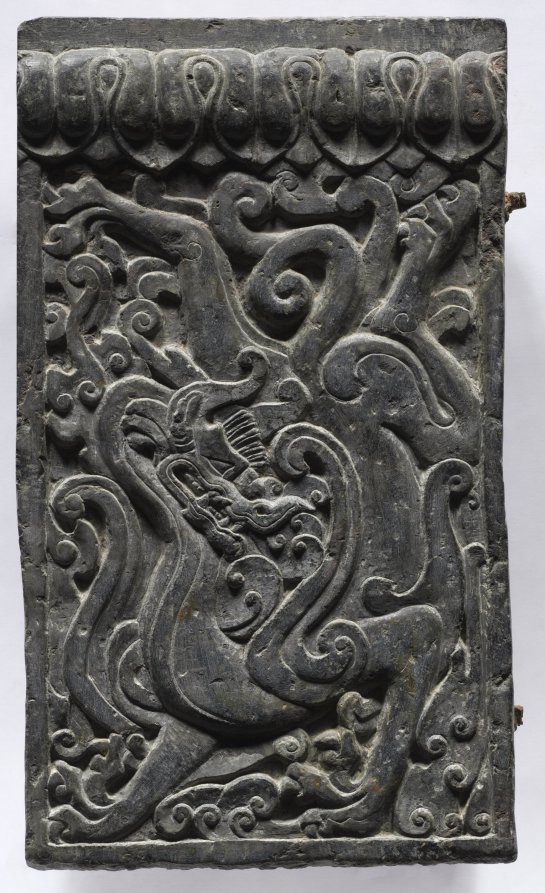
Section of a Coffin Platform: Dragon
550–77
- Medium
- limestone
- Classification
- Sculpture
- Dimensions
- Overall: 45.7 x 211.4 x 10.8 cm (18 x 83 1/4 x 4 1/4 in.); Panel: 45.7 x 26.3 x 10.8 cm (18 x 10 3/8 x 4 1/4 in.)
- Culture
- China, Northern Qi dynasty (550-577)
- Museum
- Cleveland Museum of Art, Chinese Art
- Credit line
- Gift of Mr. and Mrs. Oscar Lange
- Rights
- Public domain (CC0), as the museum states it.
- Who can see it
- Teens profiles and older: its subject is for older viewers (war, death, the Passion, drink or the like). How works are placed
View at the Cleveland Museum of Art
About this work
This richly ornamented stone construction is the long, front side of a coffin platform ultimately derived from raised wooden beds that are still popular in China today. Now in five pieces (presumably cut to facilitate transportation after it was excavated in the 1900s), the three legs and horizontal spans may have originally been created as a single massive slab. Sockets cut in the top of the stone (some of which overlap the modern divisions) show how this slab would have been linked to the back with crosspieces also capable of supporting a top surface of flat stone planks.
Like the few examples discovered intact in northern Chinese aristocratic tombs, the most elaborate decoration occurs on the front surface of the coffin platform. The design is dominated by the three large vertical panels, corresponding to the legs, that contain animated high-relief depictions of three directional guardians: the White Tiger of the West, the Red Bird of the South, and the Green Dragon of the East. These three, along with the Snake-Entwined Tortoise of the North and the Yellow Dragon of the Center, were mainstays of Chinese cosmology linked, in a system devised as early as the Han dynasty, to…