Window mode follows your eyes with your camera, in this browser only: no picture or position leaves your device.
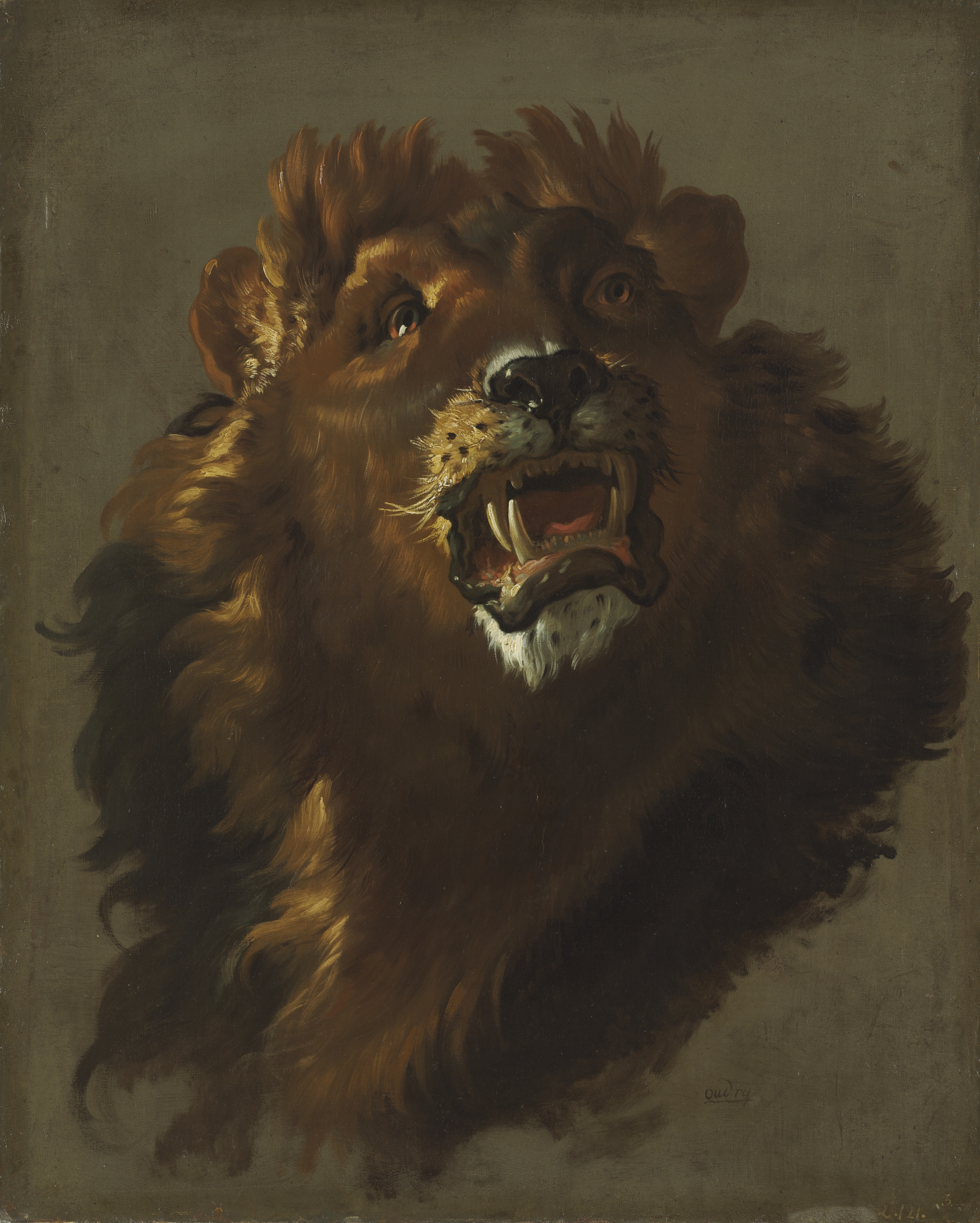
Lion
Giuseppe Baldrighi (Italian, 1723–1803)
1750s
- Medium
- oil on canvas
- Classification
- Painting
- Dimensions
- Framed: 108 x 92 x 7 cm (42 1/2 x 36 1/4 x 2 3/4 in.); Unframed: 79.5 x 64 cm (31 5/16 x 25 3/16 in.)
- Culture
- France
- Museum
- Cleveland Museum of Art, European Painting and Sculpture
- Credit line
- Bequest of Noah L. Butkin
- Rights
- Public domain (CC0), as the museum states it.
- Who can see it
- Little Ones profiles and older: it shows gentle subjects for the very young. How works are placed
View at the Cleveland Museum of Art
About this work
Looking upward with eyes gleaming and mouth open, the lion conveys wild elegance. The sketch comprises short brushstrokes, and its most striking detail is the thick and plentiful mane. Undefined planes of black make up the lion's longest tresses, but closer to the face, the mane becomes increasingly light. Although the darkest parts of the mane lack precise definition, the chestnut shades of the mane host shadows and highlights that lend a sense of realism. Additionally, varied shades of brown are contrasted by the lighter, creamier shades of white at the lion's muzzle. The lifelike nature of this sketch is further communicated by the bright, wet patches on the lion's nose and mouth. Likewise, a bright glimmer in the lion's right eye illustrates its vitality. At the bottom right of the lion, a small signature attributes the painting to the French animal painter Jean-Baptiste Oudry, although this signature was a later addition. This is actually the work of the Italian painter Giuseppe Baldrighi, court artist to the Dukes of Parma. Sent to Paris in 1752, Baldrighi studied with a number of leading French painters, including Oudry, leading to a number of animal studies in Oudry's…