Window mode follows your eyes with your camera, in this browser only: no picture or position leaves your device.
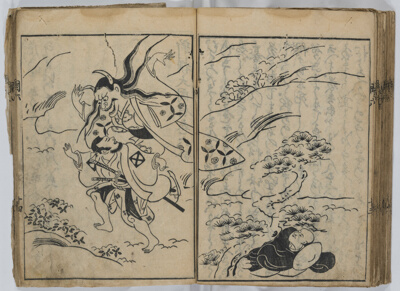
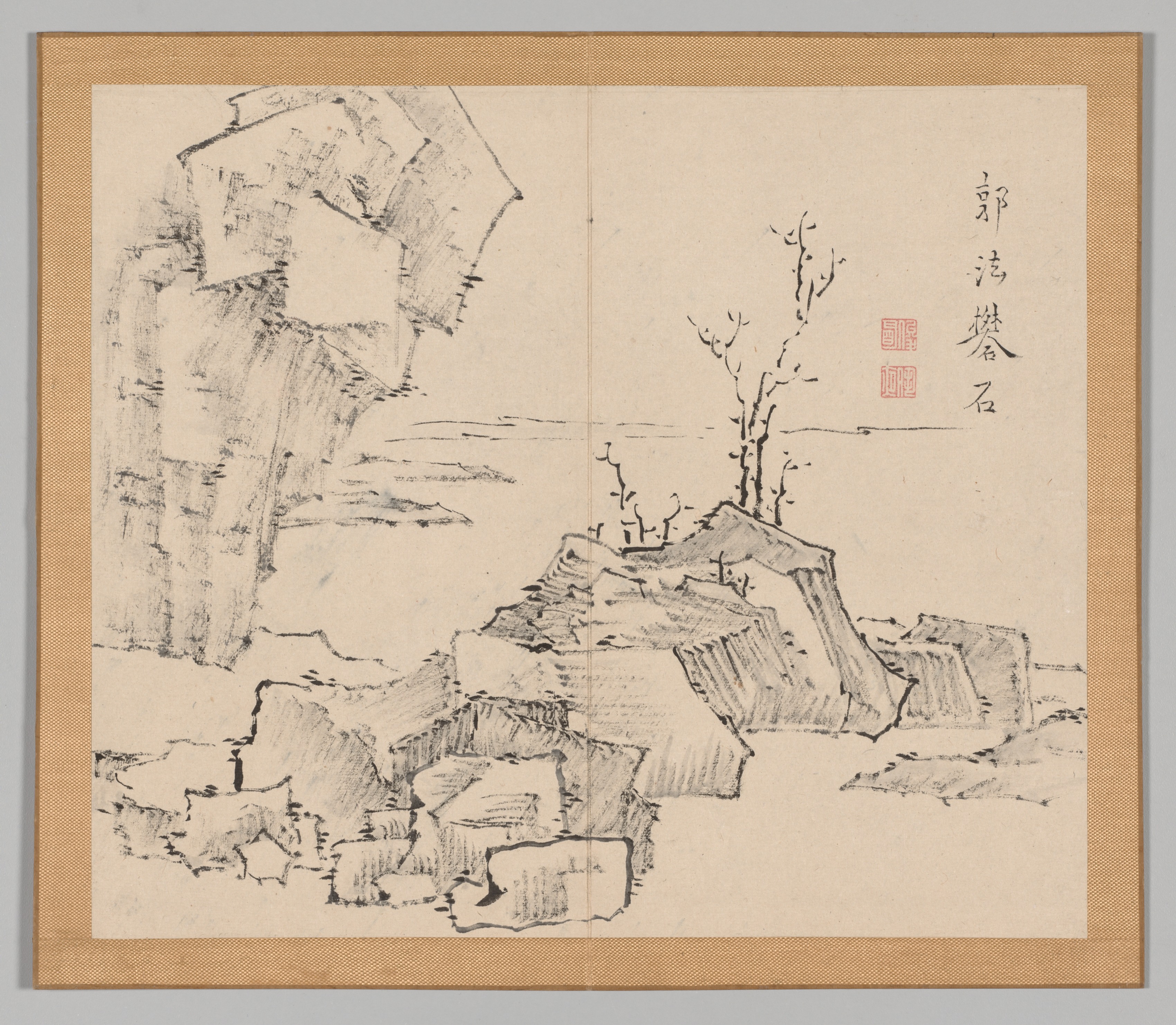
Reverberations of Taiga, Volume 1 (leaf 23)
Aoki Shukuya (Japanese, d. 1802)
mid-1700s–1802
- Medium
- double-leaf from a pair of albums; ink and light color on paper
- Classification
- Portfolio
- Dimensions
- Album, closed: 28.3 x 33 cm (11 1/8 x 13 in.)
- Culture
- Japan, Edo period (1615–1868)
- Museum
- Cleveland Museum of Art, Japanese Art
- Credit line
- Andrew R. and Martha Holden Jennings Fund
- Rights
- Public domain (CC0), as the museum states it.
- Who can see it
- Teens profiles and older: its museum says too little about what it shows to place it for younger viewers. How works are placed
View at the Cleveland Museum of Art
About this work
Aoki Shukuya was a top student of painter Ike Taiga and took responsibility for Taiga’s stylistic legacy. A painting album by Taiga, part of which survives today in Kyoto in hanging scroll format, served as the source for this painting by Shukuya and the matching designs from a set of wood-block–printed volumes published in 1804. The postscript to the books, written and carved by the scholar Minagawa Kien (皆川淇園) (1735–1807), explains that Taiga produced the original album for his wife and fellow painter Tokuyama Gyokuran (徳山玉瀾) (1727/28–1784).
Complex rock formations are accompanied by the text “Guo’s method for alunite” (郭法礬石) in a design from the second volume of the wood-block–printed set and Shukuya’s painting. This is a reference to the Northern Song–dynasty (960–1127) painter Guo Xi (郭熙) (Chinese, about 1020–1090) and a pale, often whitish mineral that forms naturally when volcanic rocks are altered by hot, acidic water.