Window mode follows your eyes with your camera, in this browser only: no picture or position leaves your device.
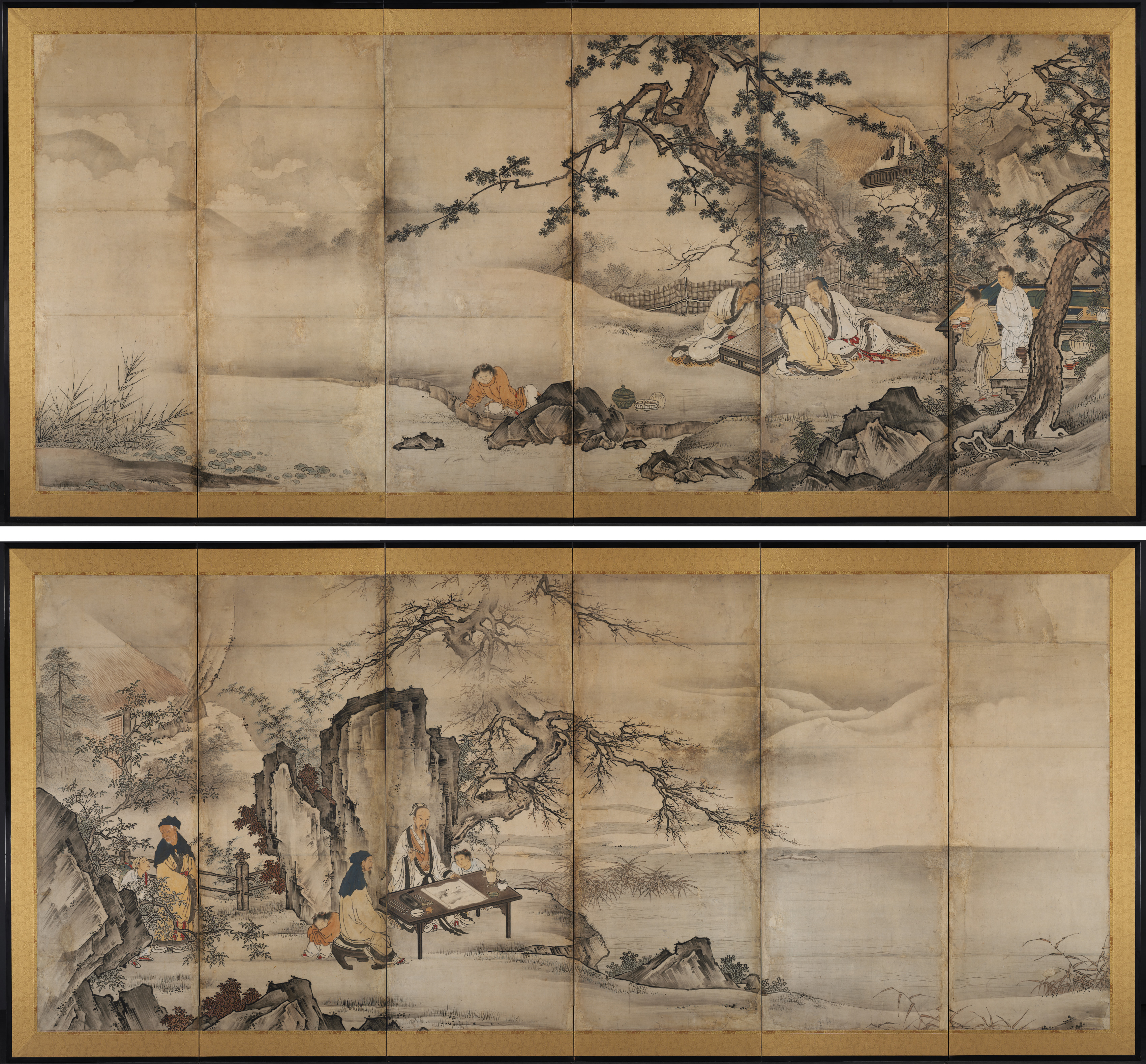
The Four Accomplishments
attributed to Kano Shōei (Japanese, 1519–1592)
late 1500s–early 1600s
- Medium
- pair of six-panel folding screens; ink and slight color on paper
- Classification
- Painting
- Dimensions
- Painting: 153 x 358.6 cm (60 1/4 x 141 3/16 in.); Mounted: 174 x 378.5 cm (68 1/2 x 149 in.)
- Culture
- Japan, Momoyama period (1573–1615)
- Museum
- Cleveland Museum of Art, Japanese Art
- Credit line
- John L. Severance Fund
- Rights
- Public domain (CC0), as the museum states it.
- Who can see it
- Teens profiles and older: its museum says too little about what it shows to place it for younger viewers. How works are placed
View at the Cleveland Museum of Art
About this work
This pair of screens shows a group of elite Chinese gentlemen and their servants in the countryside. One man is considering his painting in progress, while another looks on as two of his companions play a board game called qi, known in Japan as Go. Nearby is a table set with a selection of books ready to be read and a qin, a type of stringed instrument, still wrapped in its cloth case waiting to be played. The mood is one of enjoyment balanced with formality. Historically, playing the qin and qi along with practicing or admiring calligraphy and painting were considered four skills essential for cultured men in China.