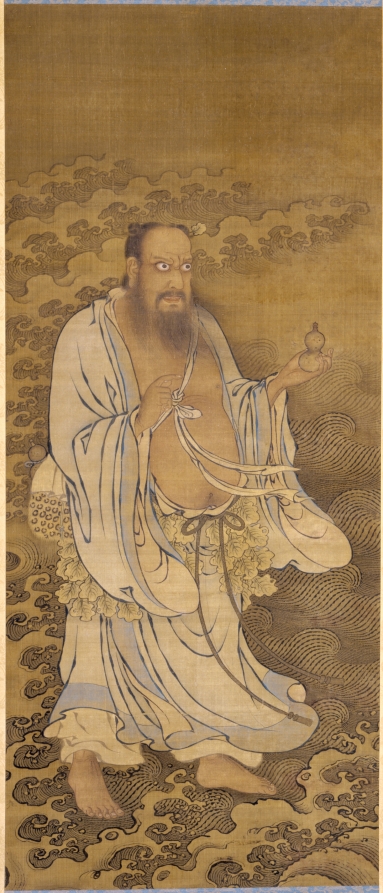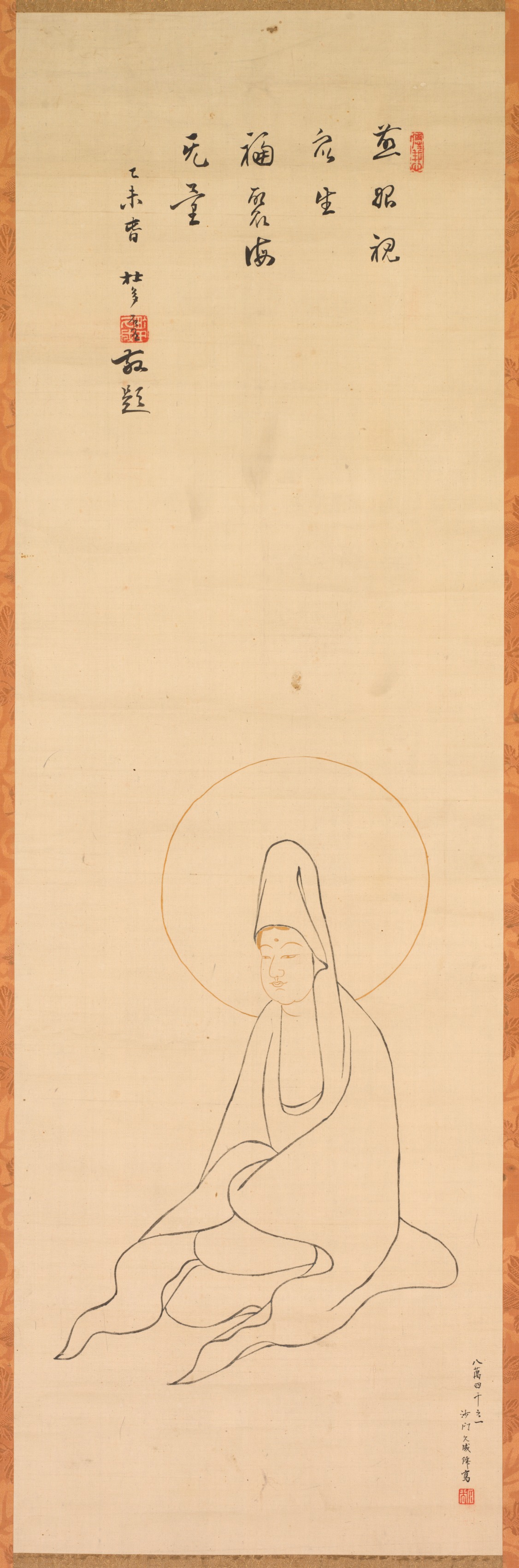
White-Robed Guanyin
copy after Jueji Yongzhong (Chinese, active around 1300)
inscription by Zhongfeng Mingben (Chinese, 1263–1323)
late 1200s–early 1300s
- Medium
- hanging scroll; ink and gold on silk
- Classification
- Painting
- Dimensions
- Painting: 80.7 x 25.7 cm (31 3/4 x 10 1/8 in.); Overall with knobs and cord: 168.2 x 44.5 cm (66 1/4 x 17 1/2 in.)
- Culture
- China, Yuan dynasty (1271-1368)
- Museum
- Cleveland Museum of Art, Chinese Art
- Credit line
- Purchase from the J. H. Wade Fund
- Rights
- Public domain (CC0), as the museum states it.
- Who can see it
- Teens profiles and older: its museum says too little about what it shows to place it for younger viewers. How works are placed
View at the Cleveland Museum of Art
About this work
The original model for this ink drawing of Guanyin, the bodhisattva of infinite compassion (Avalokiteshvara in Sanskrit), is CMA 1978.47.1. This drawing is a later copy with the same image of the White-Robed Guanyin, but in reverse. The inscription above reads: one of the 84,000 painted by the priest Insei.
The inscription seems to indicate that the Japanese priest Insei repeatedly copied the image of the bodhisattva in an act of piety and to accumulate merit, as is promised in the Lotus Sutra for anyone who paints images of the Buddha, they “will achieve the Buddha path.” The priest’s name and seal need further study and identification.