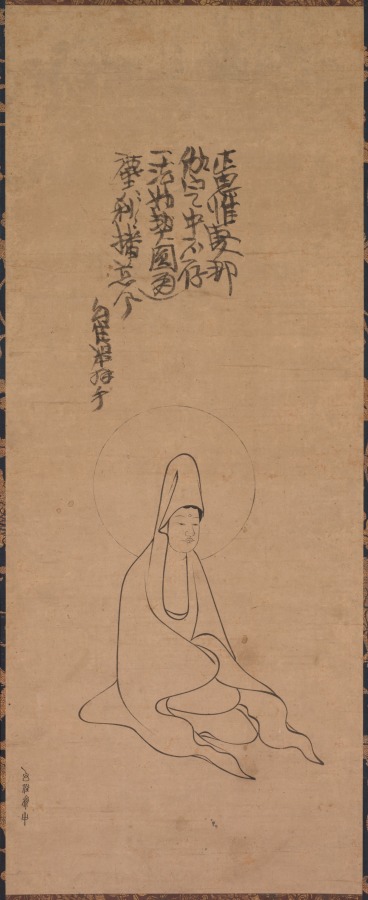
White-Robed Guanyin
Jueji Yongzhong (Chinese, active around 1300)
inscription by Zhongfeng Mingben (Chinese, 1263–1323)
late 1200s–early 1300s
- Medium
- hanging scroll; ink on paper
- Classification
- Painting
- Dimensions
- Painting: 78.7 x 31.7 cm (31 x 12 1/2 in.); Overall with knobs: 164 x 38 cm (64 9/16 x 14 15/16 in.)
- Culture
- China, Yuan dynasty (1271-1368)
- Museum
- Cleveland Museum of Art, Chinese Art
- Credit line
- Purchase from the J. H. Wade Fund
- Rights
- Public domain (CC0), as the museum states it.
- Who can see it
- Teens profiles and older: its museum says too little about what it shows to place it for younger viewers. How works are placed
View at the Cleveland Museum of Art
About this work
Guanyin, the bodhisattva of infinite compassion (Avalokiteshvara, in Sanskrit), reveals himself in many forms. According to Buddhist belief, one such manifestation is the white-robed Guanyin sitting on a rock on the island of Putuo (Potalaka, in Sanskrit), located along the coast not far from Ningbo, in Zhejiang Province, China.
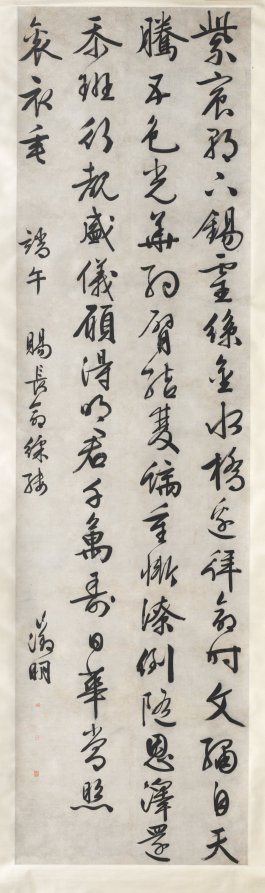
Here, the figure was swiftly drawn in only a few ink lines. The inscription above is by Zhongfeng Mingben, perhaps the most widely respected and influential Chan (Zen in Japanese) master in the Yuan dynasty. The artist’s signature is a single line below on the left: Huanzhu Yongzhong.