Window mode follows your eyes with your camera, in this browser only: no picture or position leaves your device.
Flowers of Four Seasons, with Poems
Wang Guxiang (Chinese, 1501–1568)
1531
- Medium
- handscroll; ink and light color on silk
- Classification
- Painting
- Dimensions
- Painting only: 24 x 545 cm (9 7/16 x 214 9/16 in.); Overall: 24 x 547.5 cm (9 7/16 x 215 9/16 in.)
- Culture
- China, Ming dynasty (1368–1644)
- Museum
- Cleveland Museum of Art, Chinese Art
- Credit line
- John L. Severance Fund
- Rights
- Public domain (CC0), as the museum states it.
- Who can see it
- Little Ones profiles and older: it shows gentle subjects for the very young. How works are placed
View at the Cleveland Museum of Art
About this work
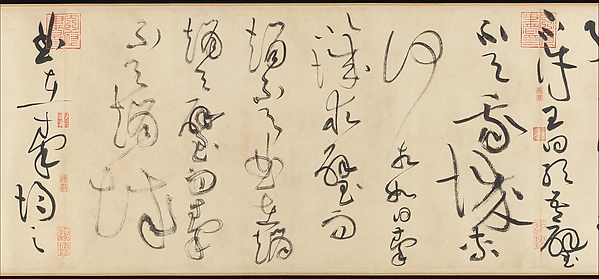
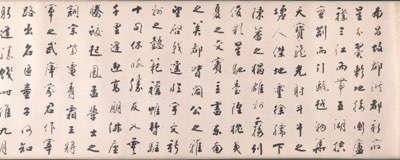
In this painting, flowers are loosely arranged by the seasons: narcissus and peony represent early spring; yellow loquat and lotus, summer; chrysanthemum, autumn; and the plum and evergreen bamboo, winter. The artist added to each flower a poetic line of calligraphy associating each plant with a historic or legendary figure. For example, the chrysanthemum, along with the line “The untrammeled joy at the eastern fence,” refers to the poet Tao Yuanming (died AD 427) who enjoyed chrysanthemums at the eastern fence in his garden. The scroll illustrates Wang Guxiang’s mastery of free brushwork, combining light monochrome ink with transparent colors. In his inscription, Wang says he used the “boneless” style without outlines as developed during the Yuan dynasty (1279–1368). Wang was a native of Changzhou, a city in southeast China known for its rich flora and fauna, and flower-and-bird painting tradition.