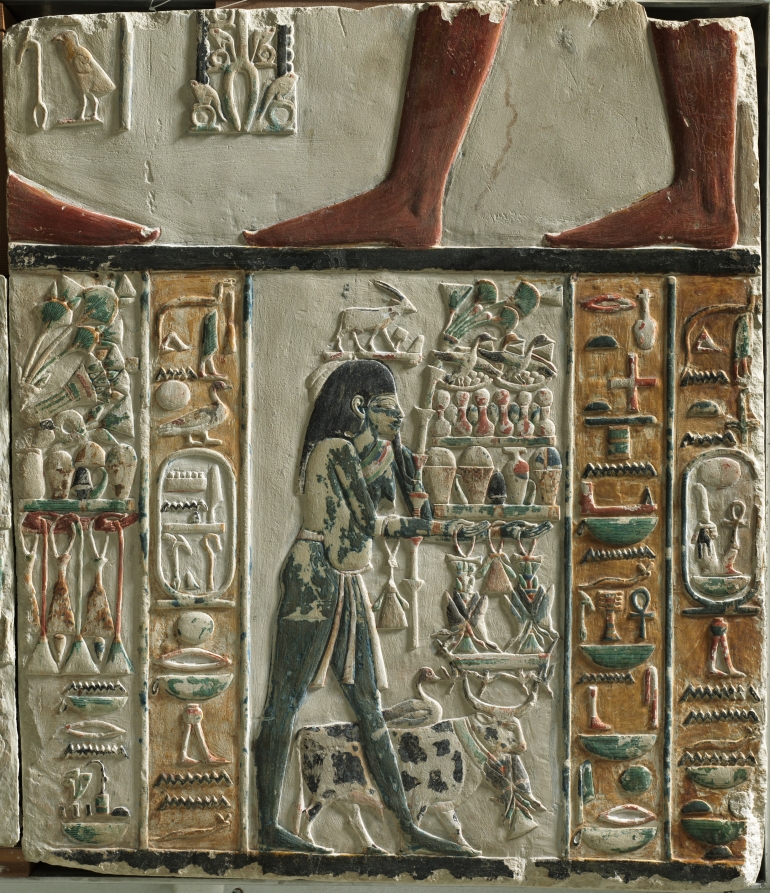
Nome Gods Bearing Offerings
c. 1391–1353 BCE
- Medium
- painted limestone
- Classification
- Sculpture
- Dimensions
- Overall: 66 x 133 cm (26 x 52 3/8 in.)
- Culture
- Egypt, New Kingdom (1540–1069 BCE), Dynasty 18, reign of Amenhotep III (1390–1352 BCE)
- Museum
- Cleveland Museum of Art, Egyptian and Ancient Near Eastern Art
- Credit line
- John L. Severance Fund
- Rights
- Public domain (CC0), as the museum states it.
- Who can see it
- Teens profiles and older: its subject is for older viewers (war, death, the Passion, drink or the like). How works are placed
View at the Cleveland Museum of Art
About this work
These blocks from a temple wall have preserved their original painted decoration to a remarkable degree. The four portly figures in the lower register bear emblems on their heads identifying them as nomes, or provinces, of ancient Egypt. Carrying trays heaped with offerings and leading sacrificial animals, they personify the bounty of the land. First (on the right) is the Oryx Nome, followed by the Dog Nome, the Falcon Nome, and the Double Scepter Nome. The face of each nome figure is a miniature portrait of Amenhotep III, and each recites a speech in the king's name. The first figure says, "King Nebmaatra [Amenhotep III] has come, bringing to you every good thing that is in this land, that you may give him all life, stability, dominion, and all health from you." The second, third, and fourth figures bring "all greens," "the produce of the Two Lands [Upper and Lower Egypt]," and "all offerings and provisions." The god to whom the nomes bring offerings stood in the fragmentary upper register, facing a standing figure of the king, Amenhotep III. The pair of legs on the right belonged to the god; the single foot on the left belonged to the king. The god held a scepter, forked at the…