Window mode follows your eyes with your camera, in this browser only: no picture or position leaves your device.
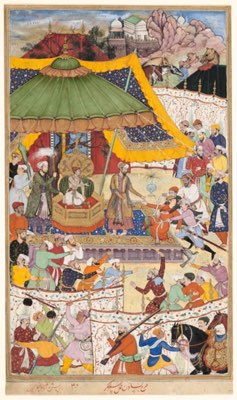
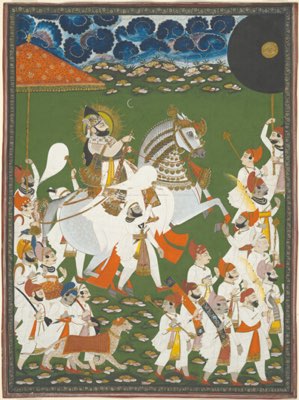
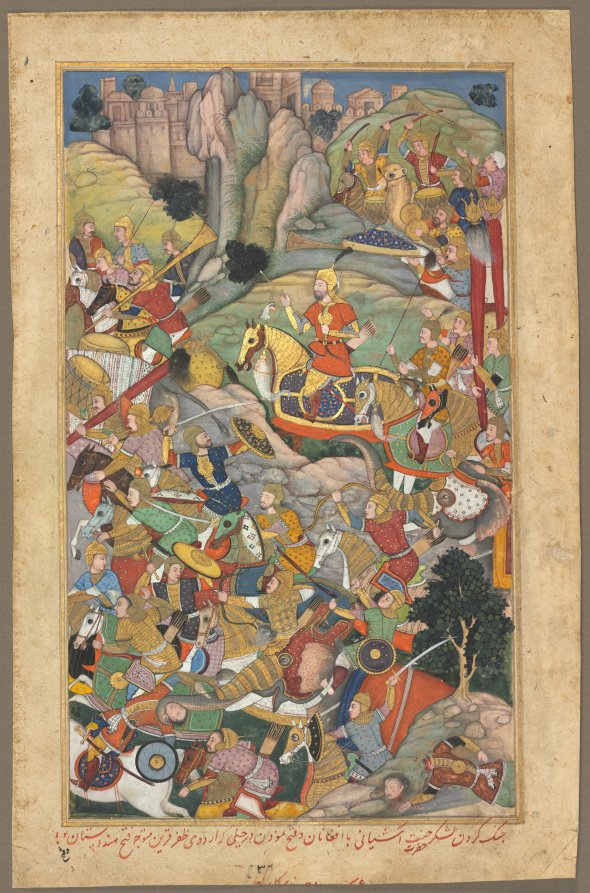
Mughal ruler Humayun defeating the Afghans before reconquering India, folio from an Akbar-nama (Book of Akbar) of Abu’l Fazl (Indian, 1551–1602)
c. 1590
- Medium
- Gum tempera, ink, and gold on paper
- Classification
- Painting
- Dimensions
- Image: 31.2 x 18.6 cm (12 5/16 x 7 5/16 in.); Overall: 36.5 x 23.1 cm (14 3/8 x 9 1/8 in.)
- Culture
- Mughal India, court of Akbar (reigned 1556–1605)
- Museum
- Cleveland Museum of Art, Indian and Southeast Asian Art
- Credit line
- Andrew R. and Martha Holden Jennings Fund
- Rights
- Public domain (CC0), as the museum states it.
- Who can see it
- Teens profiles and older: its museum says too little about what it shows to place it for younger viewers. How works are placed
View at the Cleveland Museum of Art
About this work
In a battle that took place in 1555, the second Mughal emperor, Humayun, reconquered northern India from the Afghans with the help of Iranian military forces. His mounted figure stands out from the fray, with his golden helmet and red tunic silhouetted against a hillside in the upper center of the composition. To illustrate the beginning of hisown biography, Humayun’s son Akbar included this image of his father riding victoriously back to India. The scene never actually occurred in this way, since Humayun did not participate in this particular battle; his inclusion here is symbolic.