Window mode follows your eyes with your camera, in this browser only: no picture or position leaves your device.
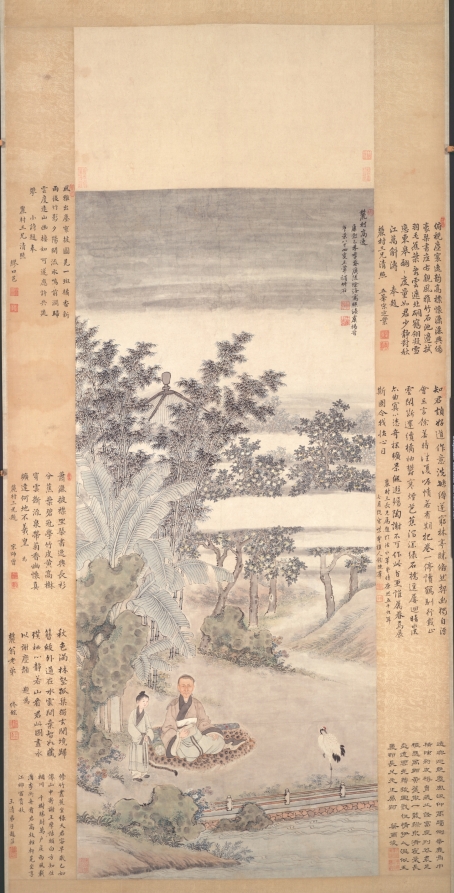
Portrait of An Qi
Wang Hui (Chinese, 1632–1717)
Tu Luo (Chinese, active c. 1715)
Yang Jin (Chinese, 1644–1728)
1715
- Medium
- hanging scroll; ink and color on paper
- Classification
- Painting
- Dimensions
- Image: 122 x 53.6 cm (48 1/16 x 21 1/8 in.); Overall: 259.7 x 80.1 cm (102 1/4 x 31 9/16 in.)
- Culture
- China, Qing dynasty (1644–1911)
- Museum
- Cleveland Museum of Art, Chinese Art
- Credit line
- John L. Severance Fund
- Rights
- Public domain (CC0), as the museum states it.
- Who can see it
- Tweens profiles and older: its subjects are known and suit older children. How works are placed
View at the Cleveland Museum of Art
About this work
An Qi, the subject of the portrait, was a second-generation salt merchant from Korea. He used part of his wealth to collect art. At the time this painting was commissioned, An was less than 40 years old. He is represented as a Daoist recluse in nature, informally dressed with attributes such as books and a wrapped guqin instrument, a portrait convention for literati-scholars since the Six Dynasties period (220–589 CE). The local Taihu rock, banana plants, and crane suggest a southern garden and a life in seclusion. An’s portrait is evidence of merchants aspiring to the scholar-official class.
According to the inscription, this painting was the joint effort of three men, the eldest and most famous was Wang Hui. While the garden setting is homogenous in style, it contrasts with the application of opaque pigments and shading employed for the depiction of An Qi’s face.