Window mode follows your eyes with your camera, in this browser only: no picture or position leaves your device.
The Five Hundred Arhats
Wu Bin (Chinese, active c. 1591–1626)
1591–1626
- Medium
- Handscroll; ink and color on paper
- Classification
- Painting
- Dimensions
- Overall: 39.5 x 2646.5 cm (15 9/16 x 1041 15/16 in.); Painting only: 37.7 x 2347 cm (14 13/16 x 924 in.)
- Culture
- China, Ming dynasty (1368–1644)
- Museum
- Cleveland Museum of Art, Chinese Art
- Credit line
- John L. Severance Fund
- Rights
- Public domain (CC0), as the museum states it.
- Who can see it
- Teens profiles and older: its museum says too little about what it shows to place it for younger viewers. How works are placed
View at the Cleveland Museum of Art
About this work
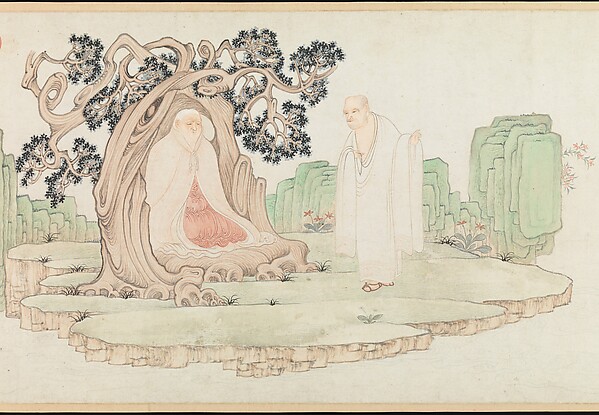
More than 66 feet long, this handscroll depicts 447 luohans, 72 attendants, and the bodhisattva of compassion at its very end. Luohans (arhats in Sanskrit), disciples of the Buddha and protectors of the Buddha’s law, possess supernatural powers and take on myriad external appearances. The amusing assortment of characters are engaged in an array of religious, secular, and miraculous activities. The painter used stylistic features borrowed from earlier artists, carefully controlled lines, and refined coloring. Wu Bin was a lay Buddhist and depicting this sort of image was part of a religious practice seeking understanding of the Buddha’s teaching.