Window mode follows your eyes with your camera, in this browser only: no picture or position leaves your device.
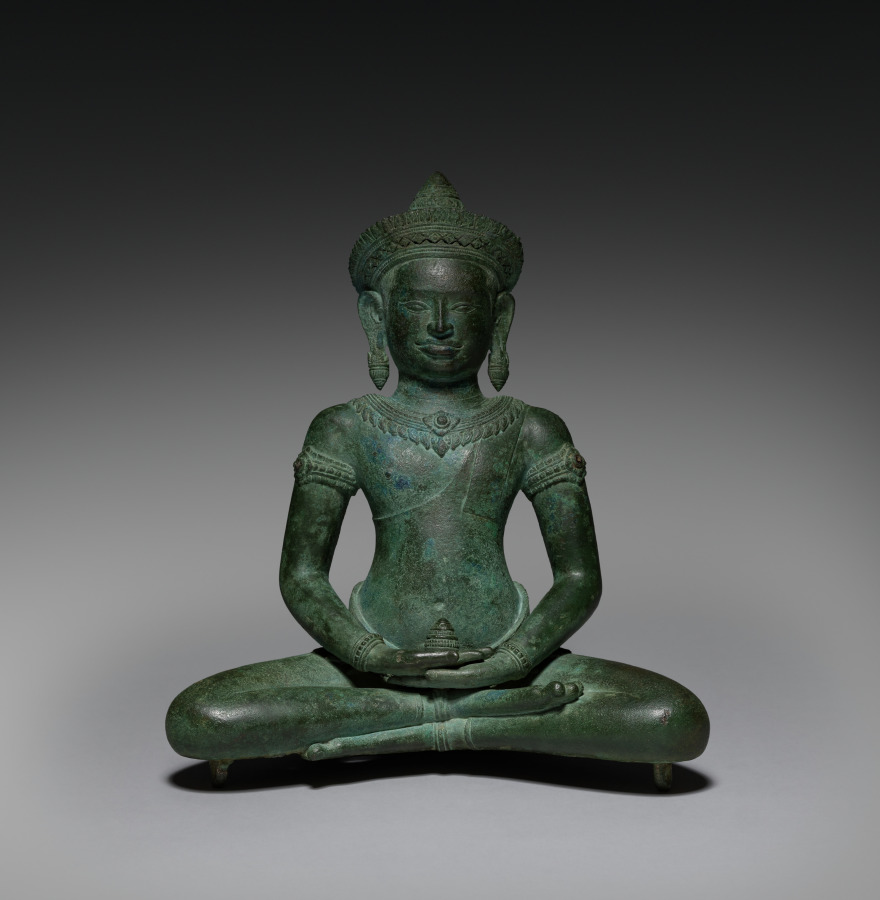
Naga-enthroned Buddha
1100–1150
- Medium
- bronze
- Classification
- Sculpture
- Dimensions
- Overall: 58.4 x 28 cm (23 x 11 in.); Figure: 31.4 x 27.6 x 18.5 cm (12 3/8 x 10 7/8 x 7 5/16 in.)
- Culture
- Cambodia, Angkor, Angkor Wat Period, 12th century
- Museum
- Cleveland Museum of Art, Indian and Southeast Asian Art
- Credit line
- John L. Severance Fund
- Rights
- Public domain (CC0), as the museum states it.
- Who can see it
- Tweens profiles and older: its subjects are known and suit older children. How works are placed
View at the Cleveland Museum of Art
About this work
Jayavarman VII, who built the great royal temple at Banteay Chhmar, linked himself with the image of the Buddha seated on a serpent, or naga, as the divine form under which he would be honored.
During his reign, the naga-enthroned Buddha became a ubiquitous image for veneration, often set up together with Lokeshvara, who was associated with his father, and Prajnaparamita, the form under which his deceased mother was honored. Lokeshvara is the powerful enlightened being of compassion, while Prajnaparmita is the goddess who personifies wisdom. King Jayavarman VII, therefore, presented himself as the enlightened Buddha, the product of the union of Compassion and Wisdom, supported and glorified by the naga, which refers to the Khmer people.
Images of the naga-enthroned Buddha have been found at Banteay Chhmar, both in architectural relief sculpture and as icons in the round. After the death of Jayavarman VII, followers of other forms of Buddhism (for example, Theravada) that became prevalent in Cambodia changed the meaning of the naga-enthroned Buddha and reinterpreted the image to refer to a scene from the historical Buddha’s life story in which a serpent protected him from a…