Window mode follows your eyes with your camera, in this browser only: no picture or position leaves your device.
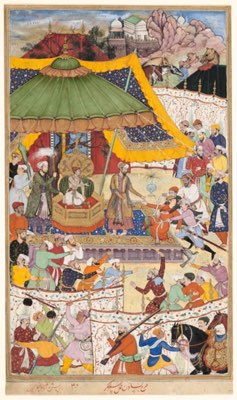
The dervish brings in as dowry an elephant laden with gold, from a Tuti-nama (Tales of a Parrot): Seventh Night
c. 1560
- Medium
- gum tempera, ink, and gold on paper
- Classification
- Painting
- Dimensions
- Overall: 20.3 x 14 cm (8 x 5 1/2 in.); Painting only: 4.2 x 9.9 cm (1 5/8 x 3 7/8 in.)
- Culture
- Mughal India, court of Akbar (reigned 1556–1605)
- Museum
- Cleveland Museum of Art, Indian and Southeast Asian Art
- Credit line
- Gift of Mrs. A. Dean Perry
- Rights
- Public domain (CC0), as the museum states it.
- Who can see it
- Kids profiles and older: it shows nature, places, still life or a children's book. How works are placed
View at the Cleveland Museum of Art
About this work
The eccentric dervish, wearing a fur cap, a leopard-skin skirt, and chains around his neck, chest, and legs, comes to the king with the very thing the king thought he could never provide: an elephant laden with gold in exchange for the princess’s hand in marriage. The dervish had gone to the magnanimous King of Kings—the overlord of this local king—with his plight: in order to marry the princess, he had to provide an elephant laden with gold as a dowry. The King of Kings, who could not resist a good love story, provided it for him. The text of the story is written in Persian in a naskh script, which is read from right to left.