Window mode follows your eyes with your camera, in this browser only: no picture or position leaves your device.
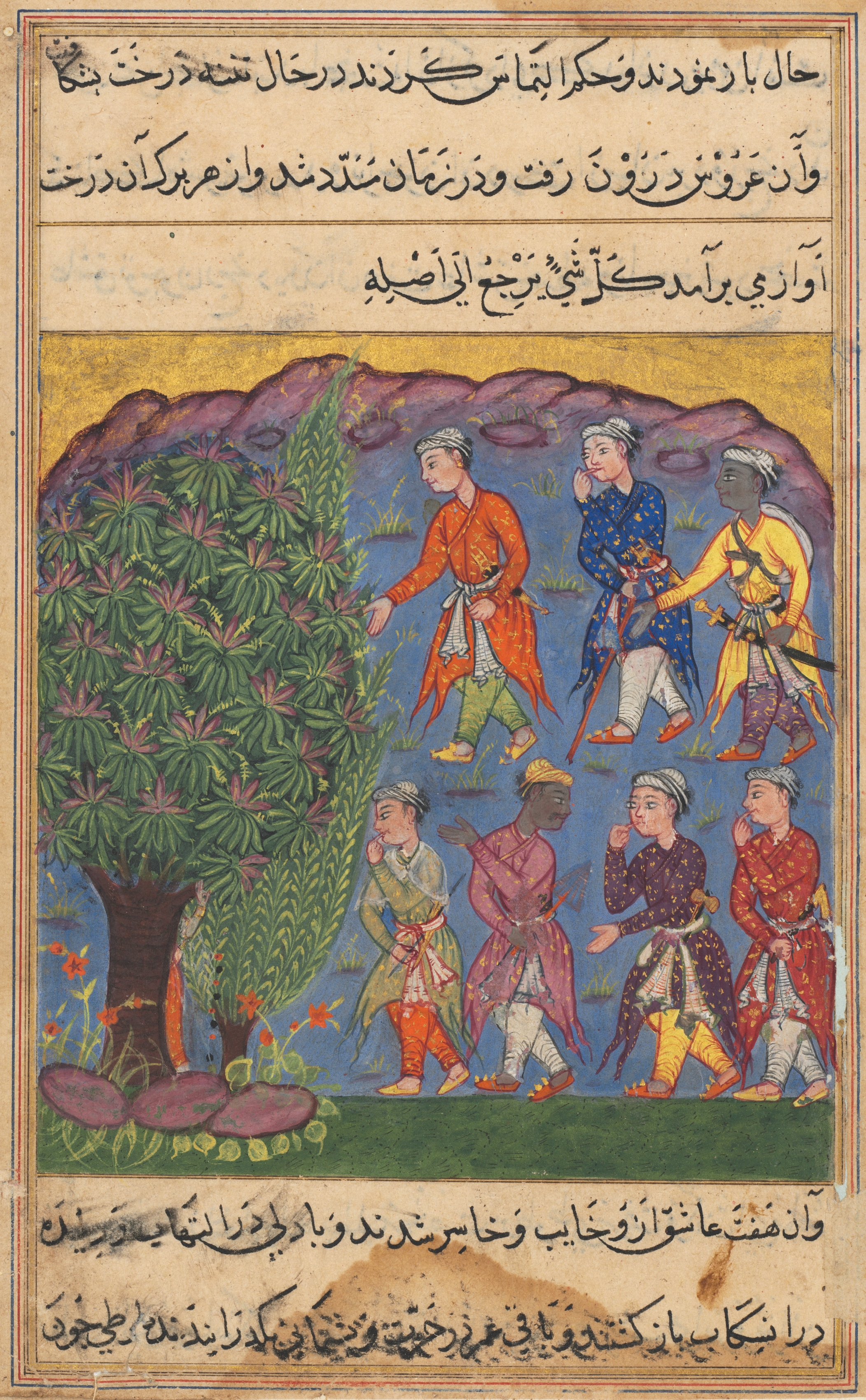
Seven men disputing possession of a woman bring her before the Tree of Justice into which she is absorbed, from a Tuti-nama (Tales of a Parrot): Sixth Night
c. 1560
- Medium
- gum tempera, ink, and gold on paper
- Classification
- Painting
- Dimensions
- Painting only: 10.4 x 9.8 cm (4 1/8 x 3 7/8 in.); Overall: 20 x 14.3 cm (7 7/8 x 5 5/8 in.)
- Culture
- Mughal India, court of Akbar (reigned 1556–1605)
- Museum
- Cleveland Museum of Art, Indian and Southeast Asian Art
- Credit line
- Gift of Mrs. A. Dean Perry
- Rights
- Public domain (CC0), as the museum states it.
- Who can see it
- Tweens profiles and older: its subjects are known and suit older children. How works are placed
View at the Cleveland Museum of Art
About this work
Talking trees that predict the future or administer justice recur in medieval Indo-Iranian literature. Here, the blossoming Tree of Justice settled a dispute. Seven different men wanted to marry a woman who had been carved as a wooden statue by the carpenter (lower right in red) and brought to life by the holy man (lower left in green). A sliver of the woman’s body is seen merging with the trunk. The Tree of Justice decided to absorb her, and as she disappeared the tree proclaimed: “Everything must revert to its own origin.”