Window mode follows your eyes with your camera, in this browser only: no picture or position leaves your device.
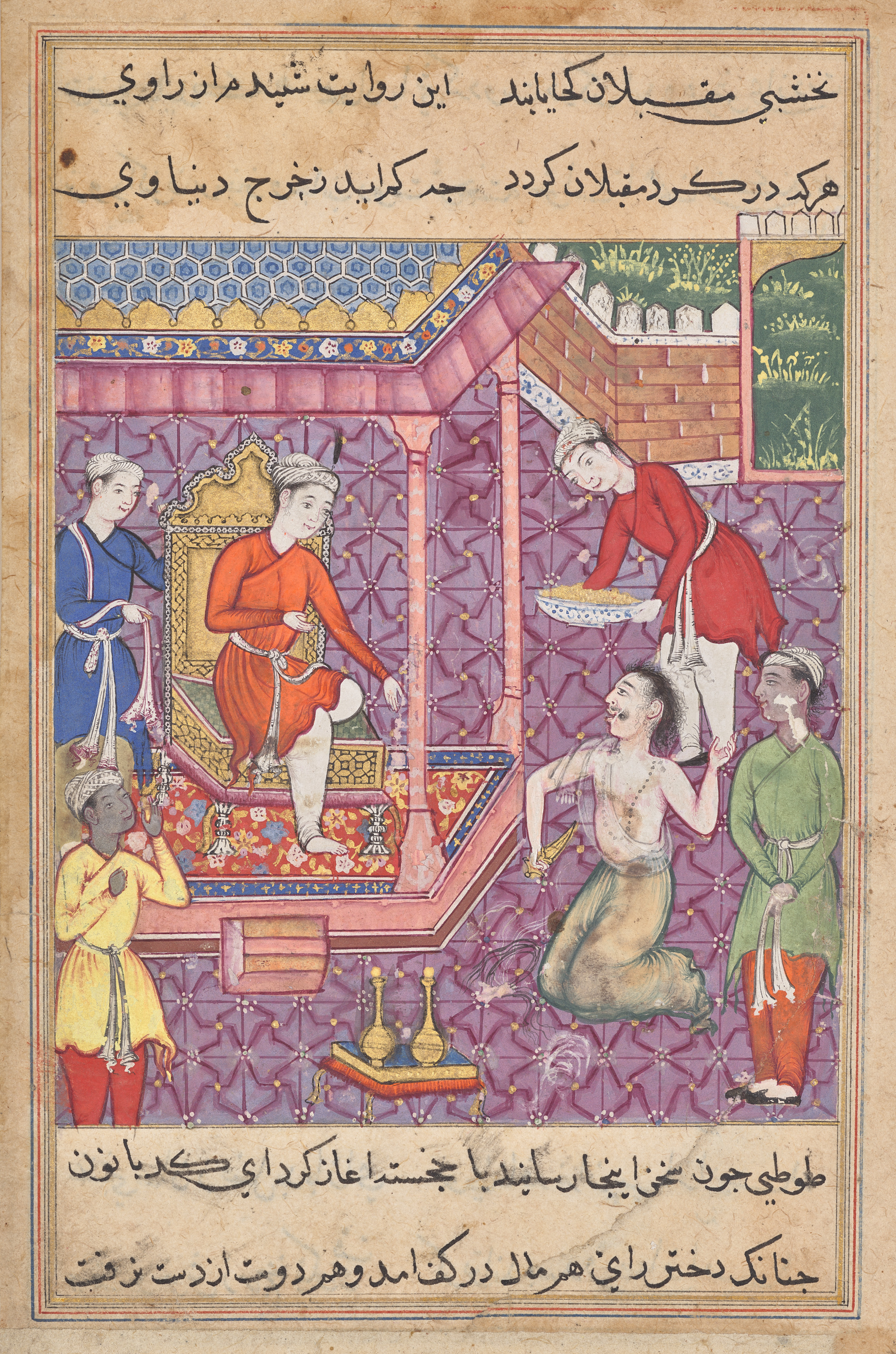
The magician disguised as a Brahman returns to claim his “daughter-in-law,” from a Tuti-nama (Tales of a Parrot): Thirty-fifth Night
c. 1560
- Medium
- gum tempera, ink, and gold on paper
- Classification
- Painting
- Dimensions
- Overall: 20.3 x 14 cm (8 x 5 1/2 in.); Painting only: 11.3 x 10.1 cm (4 7/16 x 4 in.)
- Culture
- Mughal India, court of Akbar (reigned 1556–1605)
- Museum
- Cleveland Museum of Art, Indian and Southeast Asian Art
- Credit line
- Gift of Mrs. A. Dean Perry
- Rights
- Public domain (CC0), as the museum states it.
- Who can see it
- Kids profiles and older: it shows nature, places, still life or a children's book. How works are placed
View at the Cleveland Museum of Art
About this work
The story continues with a ruse to allow the Brahman and the princess to escape the king’s son and live happily ever after. The magician transformed the lovers into men, so they were able to leave the palace unrecognized. In order to garner a fortune on which they could support themselves, the magician approached the king in the guise of a Brahman to reclaim the woman he had entrusted to the harem and who he said was his daughter-in-law. When the king stated that she has disappeared, the magician in the form of a Brahman acted as though he would stab himself to death. The king assuaged him by paying a large sum of money as compensation for losing the woman. A servant brings a blue-and-white porcelain dish full of gold coins.
A different artist painted this page without referencing the appearance of either the king or the magician in the guise of a Brahman from the previous page.