Window mode follows your eyes with your camera, in this browser only: no picture or position leaves your device.
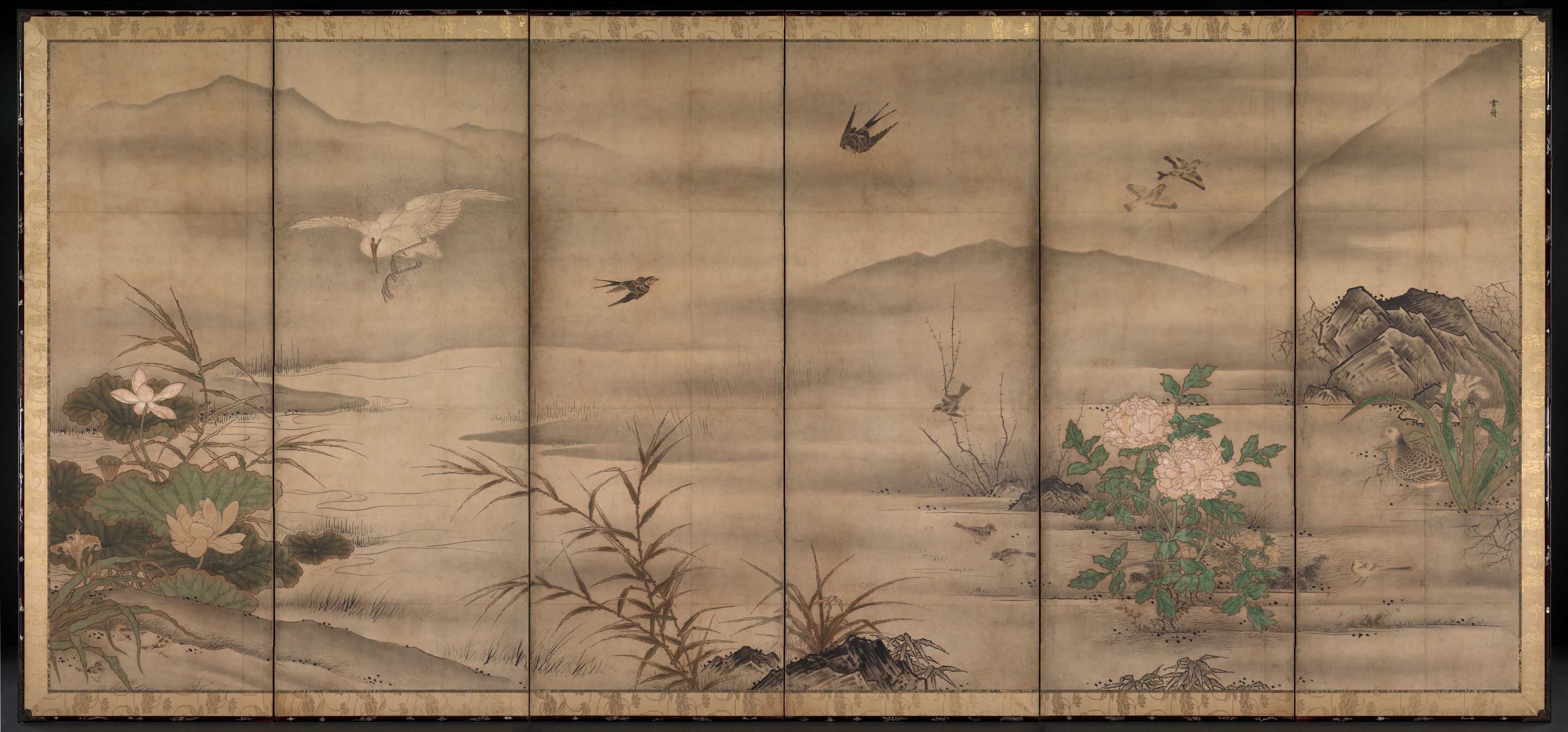
Birds and Flowers in a Landscape of the Four Seasons
follower of Sesshū Tōyō (Japanese, 1420–1506)
second half of the 1500s
- Medium
- Six-panel folding screen, ink and color on paper
- Classification
- Painting
- Dimensions
- Image: 158.5 x 359.4 cm (62 3/8 x 141 1/2 in.); Overall: 175.2 x 374.4 cm (69 x 147 3/8 in.)
- Culture
- Japan, Muromachi period (1392–1573)
- Museum
- Cleveland Museum of Art, Japanese Art
- Credit line
- Gift of Mrs. A. Dean Perry
- Rights
- Public domain (CC0), as the museum states it.
- Who can see it
- Little Ones profiles and older: it shows gentle subjects for the very young. How works are placed
View at the Cleveland Museum of Art
About this work
The monk-painter Sesshū is revered today, as he was in his own time. While he left Kyoto's sophisticated intellectual and cultural environment to live in a provincial village in a far western province, he seems never to have severed contacts with the monastic communities of his young adulthood. His residence in Yamaguchi proved fortuitous because his patron, the region's military lord, enjoyed considerable freedom in conducting trade missions overseas with Korea and China. Sesshū went to China in 1467 and traveled about the country, visiting well-known historical sites and Chan (Zen) temples before returning two years later. Thus he became familiar with contemporary painting practices, materials, formats, and subject matter. His assimilation and then transmission of these elements had a profound impact on the following generations of ink painters, patrons, and Zen communities throughout Japan.
Despite the presence on these byōbu of the name "Sesshū," they are from the hand of another accomplished but as yet anonymous follower active in the middle of the sixteenth century. Sesshū's name here, as on a handful of similar bird-and-flower byōbu, attests to the master's identification…