Window mode follows your eyes with your camera, in this browser only: no picture or position leaves your device.
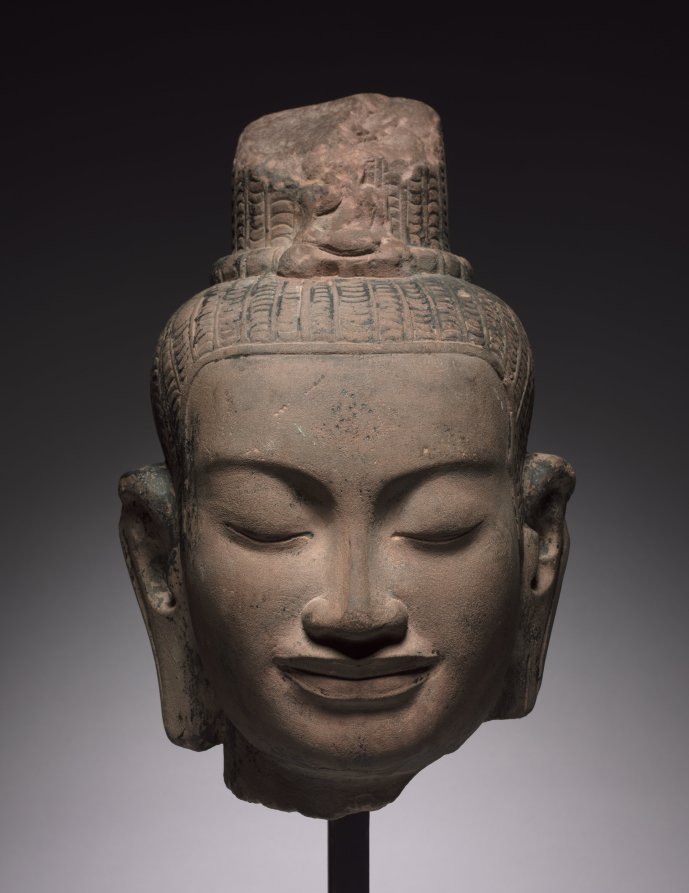
Head of Lokeshvara
late 1100s–early 1200s
- Medium
- Sandstone
- Classification
- Sculpture
- Dimensions
- Overall: 35.3 cm (13 7/8 in.)
- Culture
- Cambodia, reign of Jayavarman 7th
- Museum
- Cleveland Museum of Art, Indian and Southeast Asian Art
- Credit line
- Purchase from the J. H. Wade Fund
- Rights
- Public domain (CC0), as the museum states it.
- Who can see it
- Tweens profiles and older: its subjects are known and suit older children. How works are placed
View at the Cleveland Museum of Art
About this work
At Banteay Chhmar, none of the three-dimensional stone sculptures that were installed in the temple buildings remain standing. Only fragments of five stone sculptures of Lokeshvara have been found, and more may be recovered with future clearing of the site.
This head is stylistically similar to the ones from Banteay Chhmar and is of the type made throughout Cambodia during the reign of Jayavarman VII. Lokeshvara was the form under which his father was apotheosized and venerated.
Traces of black lacquer on the stone’s surface remain from when the head was probably refashioned into another image, likely reused for other Buddhist groups who became influential in the post-Angkorian period whose main focus was the historical Buddha rather than Lokeshvara. The lacquer, however, preserved the stone carving beneath, and it shows how the face of the bas-relief of the ten-armed Lokeshvara from Banteay Chhmar would have looked, had it not become eroded by exposure to the elements. The downcast eyes have a compassionate and meditative gaze, while the mouth smiles gently in the confidence of the power of his mercy. The small figure of a seated Buddha in front of the topknot of hair confirms…