Window mode follows your eyes with your camera, in this browser only: no picture or position leaves your device.
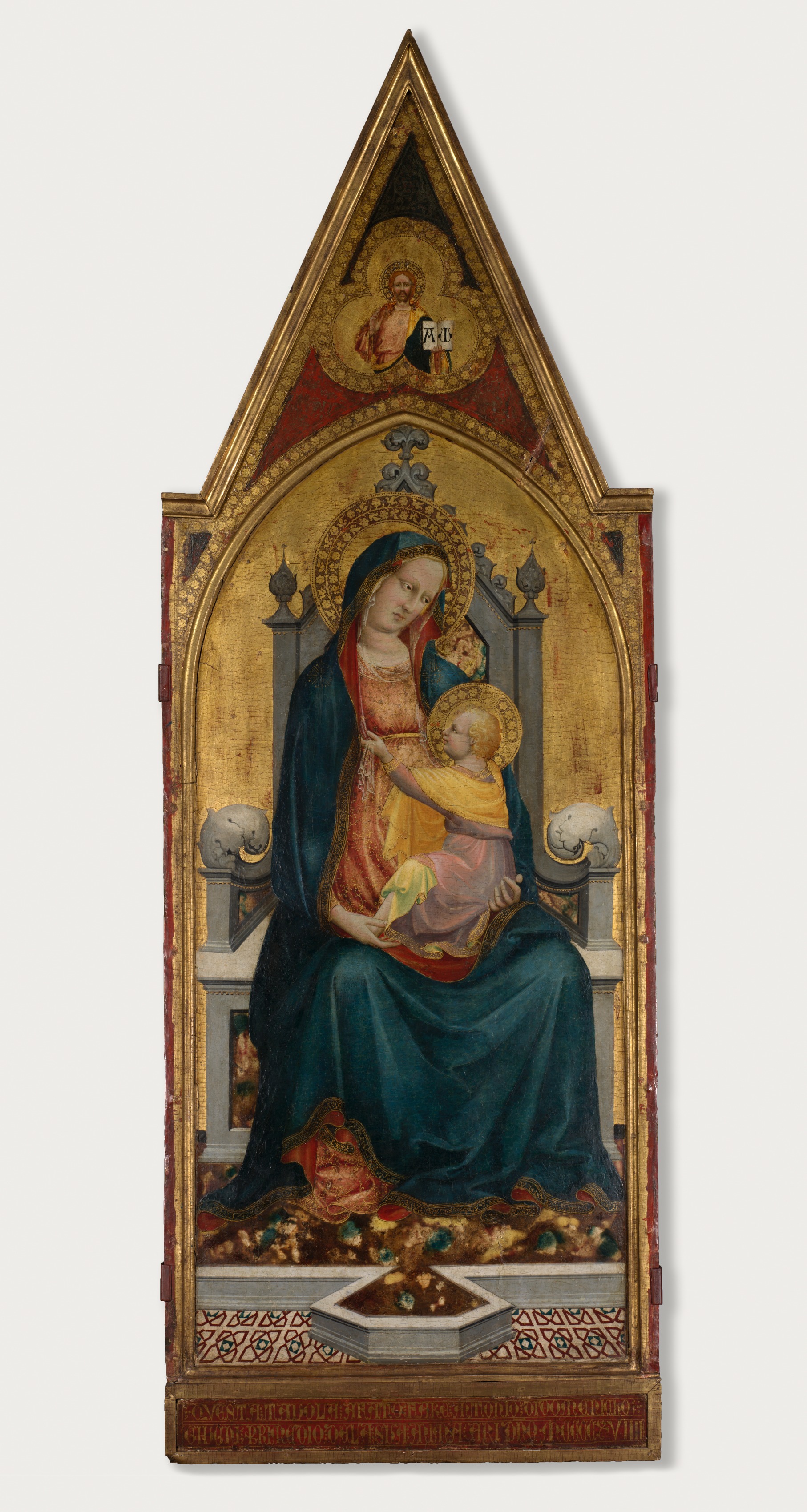
Virgin and Child Enthroned
Battista di Biagio Sanguigni (Italian, active 1393–1451)
1419
- Medium
- tempera and gold on wood
- Classification
- Painting
- Dimensions
- Framed: 196.2 x 68.6 x 9.5 cm (77 1/4 x 27 x 3 3/4 in.); Unframed: 196.2 x 68.2 cm (77 1/4 x 26 7/8 in.); with original molding and pinnacle: 129 x 59 cm (50 13/16 x 23 1/4 in.)
- Culture
- Italy, Tuscany
- Museum
- Cleveland Museum of Art, Medieval Art
- Credit line
- Gift of the Hanna Fund
- Rights
- Public domain (CC0), as the museum states it.
- Who can see it
- Tweens profiles and older: its subjects are known and suit older children. How works are placed
View at the Cleveland Museum of Art
About this work
Rather than depicting a single moment in time, this gold-ground painting symbolically encapsulates Christ. Seated on a rich throne, the monumental Virgin holds the Christ child. Above, the risen Christ is seen in heaven holding a book, inscribed with the alpha and omega, the first and last letters of the Greek alphabet, signifying Christ’s role as the beginning and end of all things. The Italian inscription states: "This painting was made for Antonio di Domenicho Giugni for the repose of his soul, the year of our Lord 1419." In the 1300s, Italian painting focused on the heavenly aspects of Christian faith in order to convey abstract religious concepts. Depicted as specimens of formal beauty, sacred figures were placed against an ethereal gold background. Within a hundred years, artists began to highlight the earthly aspects of sacred figures, placing them within naturalistic landscapes. In this newer style of painting, the approachability of sacred figures fostered devotion among the faithful.