Window mode follows your eyes with your camera, in this browser only: no picture or position leaves your device.
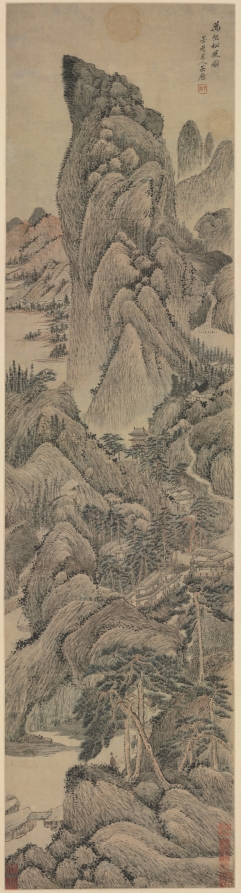
Pine Wind from Myriad Villages
Wu Li (Chinese, 1632–1718)
late 1600s–1718
- Medium
- Hanging scroll; ink and light color on paper
- Classification
- Painting
- Dimensions
- Image: 109.5 x 25.9 cm (43 1/8 x 10 3/16 in.); Overall: 207 x 44.9 cm (81 1/2 x 17 11/16 in.)
- Culture
- China, Qing dynasty (1644–1911)
- Museum
- Cleveland Museum of Art, Chinese Art
- Credit line
- John L. Severance Fund
- Rights
- Public domain (CC0), as the museum states it.
- Who can see it
- Little Ones profiles and older: it shows gentle subjects for the very young. How works are placed
View at the Cleveland Museum of Art
About this work
Wu Li, a native of Jiangsu province, was a talented painter, poet, and calligrapher. He studied painting with Wang Jian (1598–1677) and Wang Shimin (1592–1680), two of the “Four Wangs,” leaders of the Orthodox school of painting in the early Qing period. Through them, he also absorbed styles of earlier Ming dynasty masters.
Wu was highly praised by his contemporaries and his paintings were in demand, but his interest in philosophy and religion curtailed his painting activities later in life. Wu Li converted to Christianity and in 1688 was ordained as one of the first 3 Chinese Jesuit priests. He spent the final 30 years of his life primarily in missionary work with the poor.
Although this painting is undated, the sooty blackness of the ink tones and the easy self-confidence with which they are set down on paper echo recognized late works.