Window mode follows your eyes with your camera, in this browser only: no picture or position leaves your device.
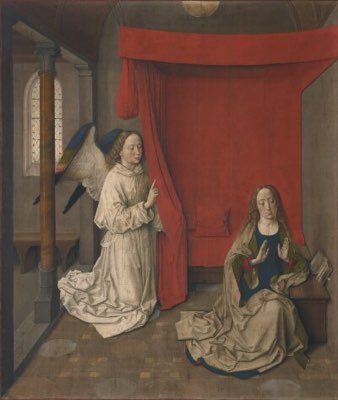
The Annunciation
Jaume Ferrer the Younger (Spanish, Catalonia died c. 1460/70)
c. 1457
- Medium
- oil, tempera, and gold on wood panel (fir)
- Classification
- Painting
- Dimensions
- Framed: 186.5 x 139 x 14.5 cm (73 7/16 x 54 3/4 x 5 11/16 in.); Unframed: 172 x 124.7 cm (67 11/16 x 49 1/8 in.)
- Culture
- Spain, Catalonia, 15th century
- Museum
- Cleveland Museum of Art, Medieval Art
- Credit line
- Gift of Francis Ginn, Marian Ginn Jones, Barbara Ginn Griesinger, and Alexander Ginn in memory of Frank Hadley Ginn and Cornelia Root Ginn
- Rights
- Public domain (CC0), as the museum states it.
- Who can see it
- Tweens profiles and older: its subjects are known and suit older children. How works are placed
View at the Cleveland Museum of Art
About this work
This and 1953.660.2 are believed to be the remaining components of a six-panel altarpiece. The large central panel is now preserved in Barcelona (Museu National d’Art de Catalunya). Ferrer collaborated with the painter Pere Garcia de Benavarri on this commission. Spanish works like these often feature elaborate treatment of the gold background, evident here in the exuberant raised decoration (called pastiglia) in the skies and the haloes, as well as other details. Here the archangel Gabriel proclaims the Virgin’s destiny as the mother of Christ. The setting is an ordinary house, but simple objects have symbolic meaning. The lilies represent the Virgin’s purity; the covered jar and water carafe symbolize inviolability; the pomegranate symbolizes Christ’s resurrection, while the apple alludes to humankind’s fall from grace. The towel and basin hint at ritual cleansing during Mass. The blown-out candle points to the arrival of divine light in the world. The two books, closed and open, refer respectively to the Old and New Testaments: one foretelling and the other fulfilling the promise of the messiah.