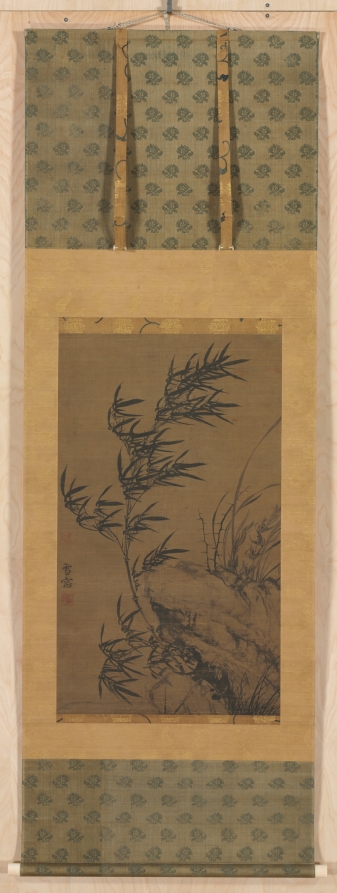
Bamboo in the Wind
Puming (Xuechuang) (Chinese, active before 1274–after 1329)
1300s
- Medium
- Hanging scroll; ink on silk
- Classification
- Painting
- Dimensions
- Painting: 77.6 x 45.7 cm (30 9/16 x 18 in.); Overall with knobs: 209.5 x 75.5 cm (82 1/2 x 29 3/4 in.)
- Culture
- China, Yuan dynasty (1271–1368)
- Museum
- Cleveland Museum of Art, Chinese Art
- Credit line
- John L. Severance Fund
- Rights
- Public domain (CC0), as the museum states it.
- Who can see it
- Little Ones profiles and older: it shows gentle subjects for the very young. How works are placed
View at the Cleveland Museum of Art
About this work
Bamboo is an evergreen plant that does not break under the weight of snow or the force of the wind, and thus became a favorite motif in literati painting and Chan Buddhism as a metaphor for the virtue of not yielding to worldly temptations.
Xuechuang, also known as monk Puming, was a native of Songjiang, near Shanghai, who spent his life as a monk in Suzhou. In 1338, he presided over Yunyan temple on Tiger Hill. Here, he masterfully depicts a bamboo gently bent in a subtle breeze. Puming’s paintings were revered in Japan and Korea.